The Boy In The Red And White Striped Shirt

Source: The Boy In The Red And White Striped Shirt – Cathy Buckle Dear Family and Friends, Long time readers of my Letters From Zimbabwe and followers of events here, will know that South Africa has long been our safe haven. Thank you, South Africa, you have been our comfort, our refuge and our safety. […]

The post The Boy In The Red And White Striped Shirt appeared first on Zimbabwe Situation.

Source: The Boy In The Red And White Striped Shirt – Cathy Buckle

Dear Family and Friends,

Long time readers of my Letters From Zimbabwe and followers of events here, will know that South Africa has long been our safe haven.

Thank you, South Africa, you have been our comfort, our refuge and our safety. For the last 25 years you were a safe place for us to run to when things were at their worst here. A country we went to when violent land invaders were evicting farmers and their workers and burning and looting our farms. A place we could go to when we were escaping political persecution, brutality, violence and torture before, during and after every rigged, contested election. When there was literally no food to buy in our shops we came to South Africa and bought our groceries there and you welcomed us. When there were, and still are, no jobs with livable wages in Zimbabwe and we could not survive, you gave us work so that we could send money home to our families in Zimbabwe to buy food and medicine, pay rent and school fees.

This week everything changed.

It has been unbearably painful watching our best friends turning against us this week. Not the South African government or their officials or even the police but protestors. Black South Africans attacking black people from other African countries they accuse of being undocumented. But it is not just undocumented African migrants who are running for their lives and the fear is everywhere. Many legally documented Zimbabweans have also been targeted, threatened, intimidated, attacked and had their property taken. Hearing snatches of scared, desperate voices of Zimbabweans in long queues at ‘holding centers’ trying to get away from the place that has been their home, their safety and their sanctuary for years has been heartbreaking: “They just came and chased us out of our homes;” “they didn’t even ask if we had papers;” “we were so scared, we had to run for our lives;” “we are no longer wanted here;” “I had to run, I have papers but they didn’t care,” “I had to leave all my property, I am going home with nothing.”

Leaving that behind is one thing but this is what Zimbabweans are coming home to:

A government that has just passed a Bill to change the Constitution which enables the President to stay in power for an extra two years and takes away the people’s right to elect a President of their choice.

They are coming back to a country where the minimum monthly wage has just been raised to  US$90 for Gardeners and yard workers; US$99 for Cooks and Housekeepers;  US$108 for Child minders and Caregivers. Nurses will be coming home to a base salary of $250-320 a month. Teachers and public service workers to base level salaries of US$320 a month. Pensioners will be coming to a base level pension of US$70 a month if they paid into the government’s Social Security Scheme. The simple fact is that you can’t survive on these amounts in Zimbabwe and jobs are very hard to find.

To put those numbers in context: Rent is US$50-75 a month for one room, without bathroom.  Rent in a small cottage in someone else’s garden is US$300 – 500 a month and in a 3 bed house in Harare it is $850-1,400 a month, at least.

A single person’s monthly groceries are around $120 -$150 for the basics. A family of four needs $400 -$500 a month for food. Utilities and services are: Municipality US$40 – 100 a month; Electricity US$40 a month; internet & phone US$40 a month. Go anywhere by road: Fuel is US$ 2.02 a litre, compared to $1.58 in South Africa; $1.54 in Zambia; $1.53 in Botswana and $1.47 in Mozambique.

All this is what awaits Zimbabweans who are coming home. The effect of their lost jobs and incomes on the people they were supporting back in Zimbabwe is incalculable. Their remittances to Zimbabwe have been paying for school fees, medicines, groceries, rent and so much more. Zimbabweans in South Africa send home roughly US$58 – 62 million every month through formal channels alone. (Bloomberg) Their remittances are so important to the Zimbabwe government that they are even factored into our national annual budget.

There are a hundred opinions about the events in South Africa this week; about thousands and thousands of people desperately trying to escape South Africa, about who is to blame, about the ordinary, good, kind, decent South Africans who have only ever been our friends and tried to help us. But most importantly the question on everybody’s lips is why didn’t South Africa enforce their own regulations about undocumented migrants but instead leave it to protestors.

Despite all the questions, the why’s and what ifs, our hearts are breaking for our Zimbabweans. They made the supreme sacrifice of going to the Diaspora to support their families back in Zimbabwe and this is how it ends, at the hands of men carrying sticks and running through the streets.

In May and June 2026 over 29,000 Zimbabweans have been deported or have voluntarily repatriated from South Africa. More will follow. After it all, one image haunts me: a brief video clip yesterday of young men climbing out of windows on the top floor of a multi storey hostel and sliding down drainpipes to get away from protestors who were going door to door attacking ‘migrants’ in the building. A young boy in brown shorts and a red and white striped shirt climbed out of the window. He reached for the drain pipe but could not hold on. Every time I close my eyes I see that little boy in the red and white striped shirt falling and I am bereft.

There is no charge for this Letter From Zimbabwe but if you would like to support my writing and donate please visit my website.

Until next time, thanks for reading this Letter From Zimbabwe now in its 26th year, and my books about life in Zimbabwe, a country in waiting.

Ndini shamwari yenyu (I am your friend)

Love Cathy 3rd July 2026. Copyright © Cathy Buckle  https://cathybuckle.co.zw/

Please visit my website to see all my Books, Photobooks and Calendars https://cathybuckle.co.zw/

The post The Boy In The Red And White Striped Shirt appeared first on Zimbabwe Situation.
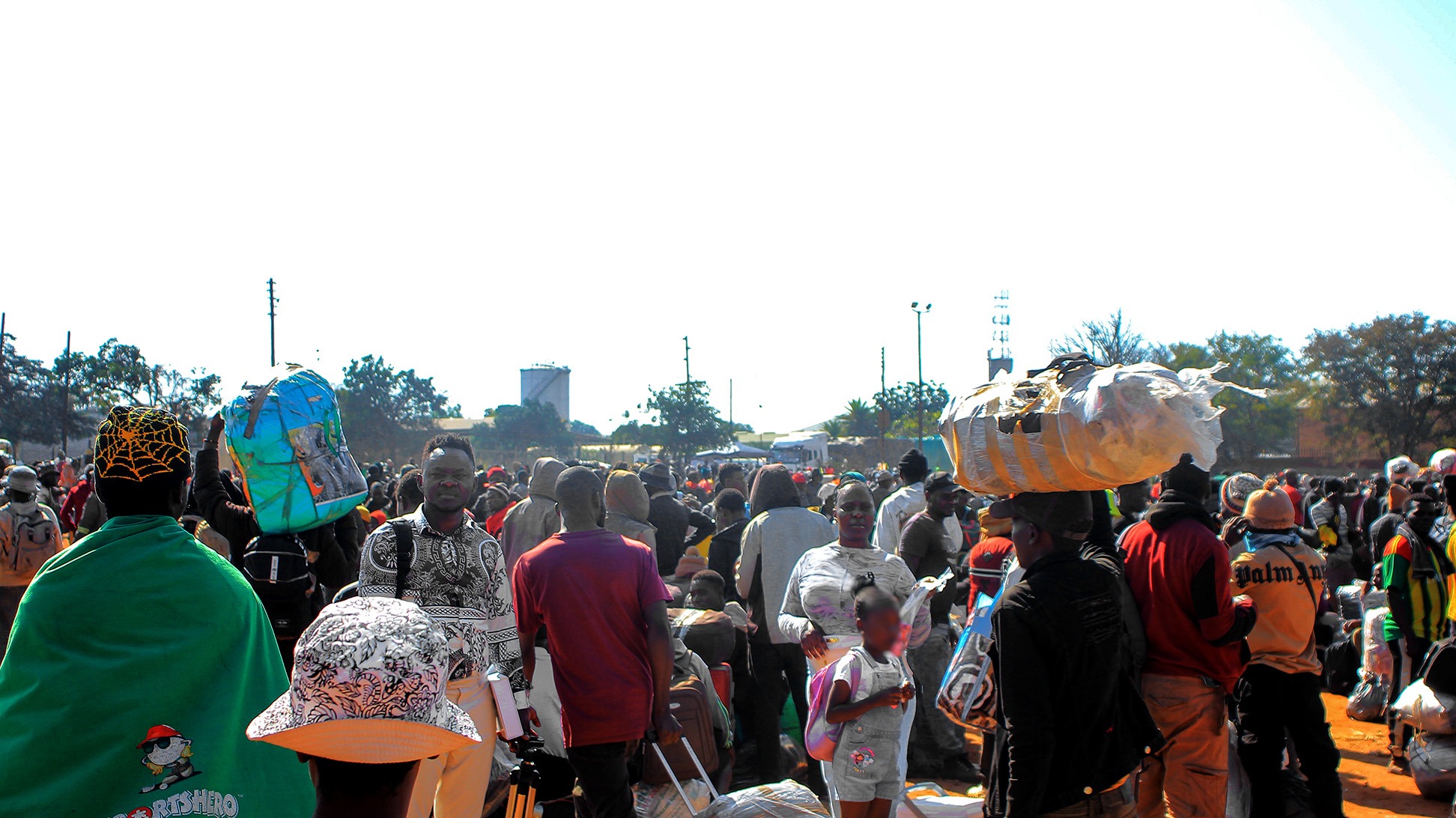
Foreign nationals in limbo in Musina as border delays mount

Source: Foreign nationals in limbo in Musina as border delays mount Thousands of foreigners, forced by the recent xenophobic protests to flee South Africa, are stranded in the border town of Musina, where many have been forced to shelter in the open as they navigate bureaucracy and problems associated with overstayed visas. Foreign nationals at […]

The post Foreign nationals in limbo in Musina as border delays mount appeared first on Zimbabwe Situation.
Source: Foreign nationals in limbo in Musina as border delays mount

Thousands of foreigners, forced by the recent xenophobic protests to flee South Africa, are stranded in the border town of Musina, where many have been forced to shelter in the open as they navigate bureaucracy and problems associated with overstayed visas.

Foreign nationals at the Musina Showgrounds. (Photo: Frans Kwinda)

Foreign nationals at the Musina Showgrounds. (Photo: Frans Kwinda)

Thousands of foreign nationals are living in limbo at the Musina Showgrounds temporary camp after document hitches and delays left them unable to cross into Zimbabwe through the Beitbridge border post.

Many have overstayed their visa in South Africa and cannot return home until they have been processed. Most have been living in the open for days.

“Some of us are unable to cross because we have overstayed,” said Munyaradzi Chitsike, a Zimbabwean from Mutare. He had been at the showgrounds for two days after travelling from Gauteng. “We don’t know what happens next. We are just waiting.”

Chitsike said thousands remain stranded between the border and the showgrounds. Most reported slow systems at Beitbridge, little food and no certainty.

Local pastor Mashudu Tswene was at the showgrounds distributing clothes and necessities to families sleeping at the camp.

He said he came after seeing how bad conditions were for women and children with no shelter or food.

Limpopo’s MEC for social development, Florence Radzilani, visited the site on Thursday and said the province was satisfied with conditions there.

“The camp is well provided for,” said Radzilani. “People have shelter, and social workers are on the ground to provide the required services.”

She thanked NGOs and stakeholders for providing humanitarian assistance at the camp.

Vhembe police Captain Vuledzani Dathi said the police were monitoring the area.

“Police are working to make sure that all the processes are in order at the border and in Musina,” said Dathi.

Long queues formed at the Musina Home Affairs office as people sought travel documents. Buses continued to arrive on Thursday from Durban, Gauteng, Eastern Cape and Western Cape, with some passengers reporting they had been on the road for four days.

One man, who asked not to be identified, said he came to South Africa to try to make a living.

“We were provided with food and everything at the Durban camp. Here in Musina there is no food and no showers,” he said.

A Malawian national at the camp said he had lived in South Africa for four years and had all the necessary documents to be in the country. He said he was leaving because of the political climate.

“Things in South Africa are bad because we are fighting for jobs with locals,” he said. “The MK party just wants everyone out. It’s chasing everyone out. I am happy that I am going back home.” DM

The post Foreign nationals in limbo in Musina as border delays mount appeared first on Zimbabwe Situation.

What the anti-migrant wave tells us about SA’s broken economic model

Source: What the anti-migrant wave tells us about SA’s broken economic model Decades of economic failure has created genuine desperation, into which an ideological campaign by mainstream economic actors has injected the false idea that we are trapped in a world of scarcity. And into this world political entrepreneurs have inserted the figure of the […]

The post What the anti-migrant wave tells us about SA’s broken economic model appeared first on Zimbabwe Situation.

Source: What the anti-migrant wave tells us about SA’s broken economic model

Decades of economic failure has created genuine desperation, into which an ideological campaign by mainstream economic actors has injected the false idea that we are trapped in a world of scarcity. And into this world political entrepreneurs have inserted the figure of the migrant as the illegitimate queue-jumper.

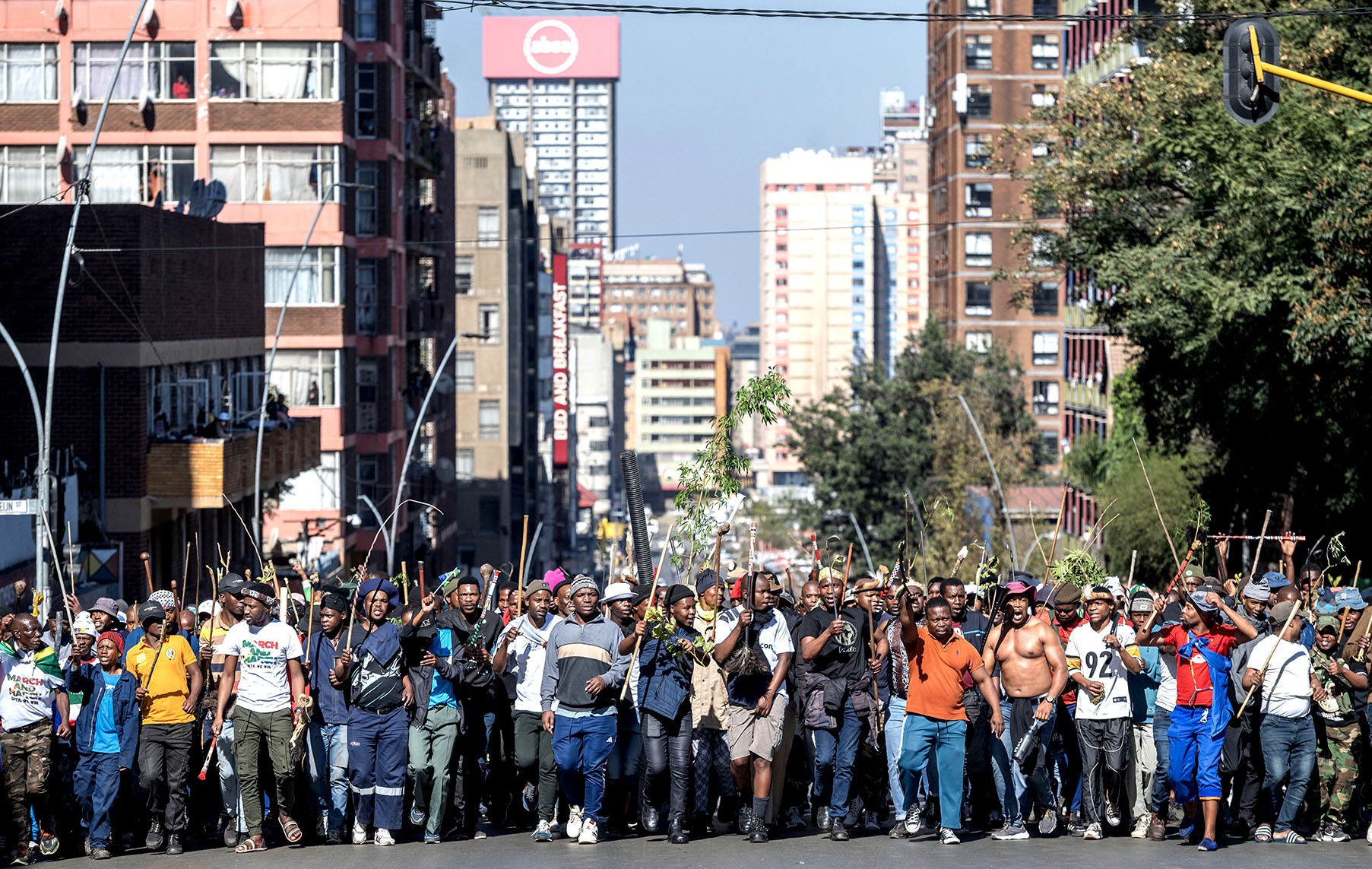
Protesters march through the Johannesburg CBD on 30 June 2026.Protesters march through the Johannesburg CBD on 30 June 2026. (Photo: Leon Sadiki)

In recent weeks South Africa has experienced some of its most significant anti-migrant mobilisation. Journalists and researchers have done important work exposing the political infrastructure behind groups like March and March, Operation Dudula and South Africans for Constitutional Reform – the organisational networks, the funding questions, the complicit political parties, the well-documented use of social media to amplify grievance before facts can be established. An understanding of the machinery is emerging.

Less examined is the economic terrain into which that machinery has been fixed. The economic context is mentioned – almost always – but typically as a backdrop rather than a subject of analysis in its own right. That needs to change. Understanding it requires grappling with several layers of economic reality. And some of those layers implicate actors who are not ordinarily part of this conversation: National Treasury, mainstream economists, the ratings agencies and the business elite.

The first layer is the one everyone acknowledges

It is not difficult to understand why many South Africans feel desperate and angry. The expanded unemployment rate stands at 44%. Youth unemployment approaches 70%. The social grants system, while vital, leaves millions below the food poverty line. Public healthcare and education have been systematically underfunded – not by accident but by policy – leaving more than 150,000 posts in the public service unfilled, many of them in frontline service delivery. People, particularly in poor and working-class communities, wait in queues at underresourced clinics. Their children grow up without meaningful economic prospects. This is widely accepted.

When basic needs go unmet, competition for scarce resources feels existential. And when political entrepreneurs with a megaphone tell you that migrants are the reason the clinic is overwhelmed, or that your child did not get a school place, or that jobs are not available, the logic is emotionally legible.

That this anger is being cynically manipulated is undoubtedly true. But revealing that is an insufficient response. Those sympathetic to anti-migrant rhetoric are not stupid or hateful per se. Most, I would assume, understood that jobs wouldn’t magically fall from the sky the day after 30 June 2026.

Rather they are responding to an economic narrative that holds even more power than anti-migrant sentiment: scarcity.

The second layer: who manufactured the scarcity?

Why has the idea of scarcity become so deeply embedded in South Africa’s public imagination? Why do so many people – across class, across education levels – believe, almost as a matter of common sense, that there simply is not enough to go around?

The answer, in significant part, is that they have been told so, repeatedly, by some of the most authoritative economic voices in the country.

For well over a decade, and with particular intensity for the past few years, the dominant economic narrative in South Africa has been one of fiscal crisis and unavoidable constraint. Treasury, mainstream economists, the ratings agencies and the business elite have generated a near-constant stream of argument insisting that the government cannot afford more – cannot afford a basic income, cannot afford to fill public service vacancies, cannot afford to properly fund health and education. The country is “living beyond its means”. We are on the edge of a “fiscal cliff”. The debt-to-GDP ratio is a source of existential alarm.

What we are dealing with is manufactured consent, the deliberate construction of a common sense that serves particular interests.

The Institute for Economic Justice has challenged this narrative systematically. We have shown that claims of an imminent fiscal crisis have been exaggerated – in some cases, dramatically so. We have shown that revenue shortfalls, when they occur, are within historical norms. We have shown that the fiscal space to fund ambitious public services exists, if the question of mobilising resources is approached seriously rather than dismissed as irresponsible. The billions we found sitting in the Gold and Foreign Exchange Contingency Reserve Account, the possibility of wealth taxes on a country that under-taxes capital, the revenue lost to tax breaks for high earners, the trillions sitting on South Africa’s balance sheets, the corporate income tax rate quietly cut – none of these features in the doom narrative. The question of distribution is systematically excluded from the dominant account of what is fiscally possible.

This is not an accident. What we are dealing with is manufactured consent, the deliberate construction of a common sense that serves particular interests. Austerity is never simply a technical policy prescription; it is a form of alchemy – transforming political choices about distribution into the appearance of economic necessity. Treasury has been, whatever its technical competence, a proponent of this magical thinking. So have many of the economists and business representatives who dominate our economic commentary.

The consequence is a public that has been successfully taught to think about resources as extremely limited and fixed – as a cake that cannot be made larger, only divided differently. In that mental world, solidarity becomes a luxury we cannot afford. Every rand spent on someone else is a rand taken from you. And if migrants are using public services – even as patients at a clinic, even as children at a school – then they are, in this logic, queue-jumpers in a line that cannot accommodate everyone.

This logic of scarcity is the fertile soil upon which the seeds of anti-migrant hate land. And economic elites bear real responsibility for it.

The third layer: what the scarcity narrative hides

The narrative of unavoidable constraint does not only shape public consciousness about what the government can afford. It also functions to deflect attention from the actual dynamics of resource distribution in this country.

South Africa is not poor in the sense of lacking wealth. It is extraordinarily unequal in the distribution of that wealth. The wealthiest individuals and corporations hold an astonishing concentration of assets. Capital has been, and continues to be, extracted from productive investment and from the tax base – through profit-shifting, through offshore financial flows, through a tax structure that privileges capital income over labour income. The deliberate under-investment in productive and social infrastructure over decades is not a story of scarcity but of choice.

When people are fighting over places in an overwhelmed clinic, the appropriate question is not whether there are enough resources to properly staff that clinic. There are. The question is why those resources are being hoarded at the top of the income distribution, why they are being spirited offshore, why they are being used to service a debt burden that reflects, in part, years of State Capture and corruption rather than investment in people’s lives.

The theft of public resources through corruption on a massive scale is itself a story about distribution, not absolute scarcity.

First, it speaks to an economy of exclusion. The failure to structurally transform the apartheid economy meant that most South Africans remain excluded, unable to generate wealth through legitimate means. In such an environment not only does joblessness flourish, so does corruption, as for many preying on the state becomes the only path available for accumulation. This is not to justify corruption, but to understand its political economy. To realise that the protection of the economic status quo post-apartheid, combined with a highly unequal economic policy regime that sought to tackle economic inclusion through “market forces”, made corruption all but inevitable.

What is absent, at every level, is the question of who actually controls the resources, and why the distribution is so fundamentally unequal.

Second, while ordinary South Africans have been robbed, through the squandering of public resources, and decimation of state-owned enterprises, the response to that robbery has been to impose austerity on those same people rather than to forge a new economic path, mobilise national resources (including through recovering what was taken) and invest them differently. These are political and distributional choices.

The anti-migrant formations do not raise these questions. They direct attention away from them. In this – even if not by design – they perform a useful ideological function for those at the top of South Africa’s economic hierarchy. The important analyses of the political dynamics beneath the surface have ignored the responsibility that economic elites bear for this crisis and the purpose it serves for them.

The political economy of the queue

Pull these layers together and a coherent picture emerges. Decades of economic failure – deindustrialisation, austerity, the looting of state resources, the systematic underfunding of public services – has created genuine desperation. Into that desperation, a sustained ideological campaign by mainstream economic actors has injected the idea that the only path to recovery is for us all to tighten our belts and shoulder more pain; that the state cannot resource what we want; that what exists must be rationed. And into this world of scarcity, political entrepreneurs have inserted the figure of the migrant as the illegitimate queue-jumper.

Each layer enables the next. The material conditions create the desperation. The scarcity narrative makes it seem permanent and zero-sum. The xenophobic mobilisation provides a target that doesn’t threaten economic power.

What is absent, at every level, is the question of who actually controls the resources, and why the distribution is so fundamentally unequal.

The solidarity we actually need

None of this is to minimise the political agency of the formations driving this crisis. March and March, Operation Dudula and the political parties that have opportunistically embraced them are responsible for incitement, for violence, for the terrorisation of families who have done nothing wrong. Migrants struggle alongside South Africans, not at our expense. Poverty will not be solved by driving Somalian shopkeepers from their stores. Hospitals will not be better resourced by turning away Malawian mothers from maternity wards.

But understanding the basis upon which this misdirection is built and who benefits from it is essential to building a response capable of countering it. The answer is not only particular political elites, but also economic elites. The latter benefit from the narrative that the status quo is unavoidable, that redistribution is impossible, that the only question is who gets the insufficient resources that exist rather than why those resources are distributed as they are.

The task for progressive forces is to offer a credible, concrete alternative: an economy that produces enough decent work, income and adequate public services for everyone who lives here, funded by genuinely mobilising the resources that exist rather than pretending they don’t. That means taxing wealth, reversing austerity, rebuilding public institutions, mobilising domestic resources and challenging those who continue to benefit from the current highly unequal distribution.

Hate thrives where hope has been exhausted. Restoring hope requires dismantling not only the political machinery of the anti-migrant wave, but the economic ideology and structures that created the fertile soil for it to take root, and to continue to produce its poisonous fruit. DM

Dr Gilad Isaacs is executive director of the Institute for Economic Justice, a progressive economic policy think-tank based in Johannesburg.

The post What the anti-migrant wave tells us about SA’s broken economic model appeared first on Zimbabwe Situation.

What the anti-migrant wave tells us about SA’s broken economic model

Source: What the anti-migrant wave tells us about SA’s broken economic model Decades of economic failure has created genuine desperation, into which an ideological campaign by mainstream economic actors has injected the false idea that we are trapped in a world of scarcity. And into this world political entrepreneurs have inserted the figure of the […]

The post What the anti-migrant wave tells us about SA’s broken economic model appeared first on Zimbabwe Situation.

Source: What the anti-migrant wave tells us about SA’s broken economic model

Decades of economic failure has created genuine desperation, into which an ideological campaign by mainstream economic actors has injected the false idea that we are trapped in a world of scarcity. And into this world political entrepreneurs have inserted the figure of the migrant as the illegitimate queue-jumper.

Protesters march through the Johannesburg CBD on 30 June 2026.Protesters march through the Johannesburg CBD on 30 June 2026. (Photo: Leon Sadiki)

In recent weeks South Africa has experienced some of its most significant anti-migrant mobilisation. Journalists and researchers have done important work exposing the political infrastructure behind groups like March and March, Operation Dudula and South Africans for Constitutional Reform – the organisational networks, the funding questions, the complicit political parties, the well-documented use of social media to amplify grievance before facts can be established. An understanding of the machinery is emerging.

Less examined is the economic terrain into which that machinery has been fixed. The economic context is mentioned – almost always – but typically as a backdrop rather than a subject of analysis in its own right. That needs to change. Understanding it requires grappling with several layers of economic reality. And some of those layers implicate actors who are not ordinarily part of this conversation: National Treasury, mainstream economists, the ratings agencies and the business elite.

The first layer is the one everyone acknowledges

It is not difficult to understand why many South Africans feel desperate and angry. The expanded unemployment rate stands at 44%. Youth unemployment approaches 70%. The social grants system, while vital, leaves millions below the food poverty line. Public healthcare and education have been systematically underfunded – not by accident but by policy – leaving more than 150,000 posts in the public service unfilled, many of them in frontline service delivery. People, particularly in poor and working-class communities, wait in queues at underresourced clinics. Their children grow up without meaningful economic prospects. This is widely accepted.

When basic needs go unmet, competition for scarce resources feels existential. And when political entrepreneurs with a megaphone tell you that migrants are the reason the clinic is overwhelmed, or that your child did not get a school place, or that jobs are not available, the logic is emotionally legible.

That this anger is being cynically manipulated is undoubtedly true. But revealing that is an insufficient response. Those sympathetic to anti-migrant rhetoric are not stupid or hateful per se. Most, I would assume, understood that jobs wouldn’t magically fall from the sky the day after 30 June 2026.

Rather they are responding to an economic narrative that holds even more power than anti-migrant sentiment: scarcity.

The second layer: who manufactured the scarcity?

Why has the idea of scarcity become so deeply embedded in South Africa’s public imagination? Why do so many people – across class, across education levels – believe, almost as a matter of common sense, that there simply is not enough to go around?

The answer, in significant part, is that they have been told so, repeatedly, by some of the most authoritative economic voices in the country.

For well over a decade, and with particular intensity for the past few years, the dominant economic narrative in South Africa has been one of fiscal crisis and unavoidable constraint. Treasury, mainstream economists, the ratings agencies and the business elite have generated a near-constant stream of argument insisting that the government cannot afford more – cannot afford a basic income, cannot afford to fill public service vacancies, cannot afford to properly fund health and education. The country is “living beyond its means”. We are on the edge of a “fiscal cliff”. The debt-to-GDP ratio is a source of existential alarm.

What we are dealing with is manufactured consent, the deliberate construction of a common sense that serves particular interests.

The Institute for Economic Justice has challenged this narrative systematically. We have shown that claims of an imminent fiscal crisis have been exaggerated – in some cases, dramatically so. We have shown that revenue shortfalls, when they occur, are within historical norms. We have shown that the fiscal space to fund ambitious public services exists, if the question of mobilising resources is approached seriously rather than dismissed as irresponsible. The billions we found sitting in the Gold and Foreign Exchange Contingency Reserve Account, the possibility of wealth taxes on a country that under-taxes capital, the revenue lost to tax breaks for high earners, the trillions sitting on South Africa’s balance sheets, the corporate income tax rate quietly cut – none of these features in the doom narrative. The question of distribution is systematically excluded from the dominant account of what is fiscally possible.

This is not an accident. What we are dealing with is manufactured consent, the deliberate construction of a common sense that serves particular interests. Austerity is never simply a technical policy prescription; it is a form of alchemy – transforming political choices about distribution into the appearance of economic necessity. Treasury has been, whatever its technical competence, a proponent of this magical thinking. So have many of the economists and business representatives who dominate our economic commentary.

The consequence is a public that has been successfully taught to think about resources as extremely limited and fixed – as a cake that cannot be made larger, only divided differently. In that mental world, solidarity becomes a luxury we cannot afford. Every rand spent on someone else is a rand taken from you. And if migrants are using public services – even as patients at a clinic, even as children at a school – then they are, in this logic, queue-jumpers in a line that cannot accommodate everyone.

This logic of scarcity is the fertile soil upon which the seeds of anti-migrant hate land. And economic elites bear real responsibility for it.

The third layer: what the scarcity narrative hides

The narrative of unavoidable constraint does not only shape public consciousness about what the government can afford. It also functions to deflect attention from the actual dynamics of resource distribution in this country.

South Africa is not poor in the sense of lacking wealth. It is extraordinarily unequal in the distribution of that wealth. The wealthiest individuals and corporations hold an astonishing concentration of assets. Capital has been, and continues to be, extracted from productive investment and from the tax base – through profit-shifting, through offshore financial flows, through a tax structure that privileges capital income over labour income. The deliberate under-investment in productive and social infrastructure over decades is not a story of scarcity but of choice.

When people are fighting over places in an overwhelmed clinic, the appropriate question is not whether there are enough resources to properly staff that clinic. There are. The question is why those resources are being hoarded at the top of the income distribution, why they are being spirited offshore, why they are being used to service a debt burden that reflects, in part, years of State Capture and corruption rather than investment in people’s lives.

The theft of public resources through corruption on a massive scale is itself a story about distribution, not absolute scarcity.

First, it speaks to an economy of exclusion. The failure to structurally transform the apartheid economy meant that most South Africans remain excluded, unable to generate wealth through legitimate means. In such an environment not only does joblessness flourish, so does corruption, as for many preying on the state becomes the only path available for accumulation. This is not to justify corruption, but to understand its political economy. To realise that the protection of the economic status quo post-apartheid, combined with a highly unequal economic policy regime that sought to tackle economic inclusion through “market forces”, made corruption all but inevitable.

What is absent, at every level, is the question of who actually controls the resources, and why the distribution is so fundamentally unequal.

Second, while ordinary South Africans have been robbed, through the squandering of public resources, and decimation of state-owned enterprises, the response to that robbery has been to impose austerity on those same people rather than to forge a new economic path, mobilise national resources (including through recovering what was taken) and invest them differently. These are political and distributional choices.

The anti-migrant formations do not raise these questions. They direct attention away from them. In this – even if not by design – they perform a useful ideological function for those at the top of South Africa’s economic hierarchy. The important analyses of the political dynamics beneath the surface have ignored the responsibility that economic elites bear for this crisis and the purpose it serves for them.

The political economy of the queue

Pull these layers together and a coherent picture emerges. Decades of economic failure – deindustrialisation, austerity, the looting of state resources, the systematic underfunding of public services – has created genuine desperation. Into that desperation, a sustained ideological campaign by mainstream economic actors has injected the idea that the only path to recovery is for us all to tighten our belts and shoulder more pain; that the state cannot resource what we want; that what exists must be rationed. And into this world of scarcity, political entrepreneurs have inserted the figure of the migrant as the illegitimate queue-jumper.

Each layer enables the next. The material conditions create the desperation. The scarcity narrative makes it seem permanent and zero-sum. The xenophobic mobilisation provides a target that doesn’t threaten economic power.

What is absent, at every level, is the question of who actually controls the resources, and why the distribution is so fundamentally unequal.

The solidarity we actually need

None of this is to minimise the political agency of the formations driving this crisis. March and March, Operation Dudula and the political parties that have opportunistically embraced them are responsible for incitement, for violence, for the terrorisation of families who have done nothing wrong. Migrants struggle alongside South Africans, not at our expense. Poverty will not be solved by driving Somalian shopkeepers from their stores. Hospitals will not be better resourced by turning away Malawian mothers from maternity wards.

But understanding the basis upon which this misdirection is built and who benefits from it is essential to building a response capable of countering it. The answer is not only particular political elites, but also economic elites. The latter benefit from the narrative that the status quo is unavoidable, that redistribution is impossible, that the only question is who gets the insufficient resources that exist rather than why those resources are distributed as they are.

The task for progressive forces is to offer a credible, concrete alternative: an economy that produces enough decent work, income and adequate public services for everyone who lives here, funded by genuinely mobilising the resources that exist rather than pretending they don’t. That means taxing wealth, reversing austerity, rebuilding public institutions, mobilising domestic resources and challenging those who continue to benefit from the current highly unequal distribution.

Hate thrives where hope has been exhausted. Restoring hope requires dismantling not only the political machinery of the anti-migrant wave, but the economic ideology and structures that created the fertile soil for it to take root, and to continue to produce its poisonous fruit. DM

Dr Gilad Isaacs is executive director of the Institute for Economic Justice, a progressive economic policy think-tank based in Johannesburg.

The post What the anti-migrant wave tells us about SA’s broken economic model appeared first on Zimbabwe Situation.

Zimbabwean regime shouldn’t play reckless political games with citizens fleeing Afrophobic attacks in South Africa

Source: Zimbabwean regime shouldn’t play reckless political games with citizens fleeing Afrophobic attacks in South Africa Being reassuring is one thing; being dishonest and misleading is another. Tendai Ruben Mbofana When political rhetoric disconnects entirely from reality, the resulting narrative is not just absurd; it is dangerous. If you value my social justice advocacy and […]

The post Zimbabwean regime shouldn’t play reckless political games with citizens fleeing Afrophobic attacks in South Africa appeared first on Zimbabwe Situation.

Source: Zimbabwean regime shouldn’t play reckless political games with citizens fleeing Afrophobic attacks in South Africa

Being reassuring is one thing; being dishonest and misleading is another.

Tendai Ruben Mbofana

When political rhetoric disconnects entirely from reality, the resulting narrative is not just absurd; it is dangerous.

If you value my social justice advocacy and writing, please consider a financial contribution to keep it going. Contact me on WhatsApp: +263 715 667 700 or Email: mbofana.tendairuben73@gmail.com

A glaring example of this disconnect was recently on full display when ZANU-PF spokesperson Chris Mutsvangwa took to the airwaves of South African television news channel Newzroom Afrika.

Confronted with the harrowing plight of thousands of Zimbabweans fleeing escalating Afrophobic violence in South Africa, Mutsvangwa boldly proclaimed that the homeland stands ready to absorb them into what he boasted is “the fastest growing economy in the region.”

To watch a senior ruling party official nonchalantly play politics with the desperate lives of our compatriots—while ordinary citizens at home are crushed under a mountain of economic misery—is both deeply infuriating and profoundly reckless.

The sheer audacity of claiming that Zimbabwe possesses the capacity to smoothly reintegrate returning migrants exposes a government completely detached from the daily struggles of its people.

Let us look at the cold, hard numbers that the state media conveniently ignores.

Today, an astounding 80 percent of ordinary Zimbabweans suffer in general poverty, while nearly 49 percent endure the indignities of extreme poverty, struggling to secure even their next meal.

Our public services have not just crumbled; they have completely collapsed.

Hospitals lack basic paracetamol and bandages, clean running water is a luxury of a bygone era, and our schools are on permanent life support.

This is the bleak landscape to which Mutsvangwa is inviting desperate families to return.

He pretends all is well back home, yet he knows very well that these migrants did not cross the Limpopo out of a desire for fun and adventure.

They fled precisely because the catastrophic policy failures of his administration rendered life at home completely unlivable.

Consider the report that approximately 56,000 Zimbabwean migrants are currently facing return due to the tightening of immigration and the hostile environment down south.

The government confidently insists it has the mechanisms to absorb them.

But into which economy?

Zimbabwe suffers from a formal unemployment rate that surpasses 90 percent.

The traditional job market is virtually dead.

The absolute majority of our population has been reduced to survivalist hustling within an overcrowded informal sector.

Drive through any town or city, and the reality is unmistakable: streets choked with citizens vending secondhand clothes, cheap plastic wares, and vegetables just to make ends meet.

To inject tens of thousands of new job-seekers into this saturated informal economy is not a plan; it is a recipe for social catastrophe.

Worse still is the sheer lack of foresight regarding the broader migration crisis.

If the government claims it can easily absorb 56,000 people, what happens if the estimated 3 million Zimbabweans currently living in South Africa—both legally and illegally—are forced back home?

The infrastructure would implode within days.

Yet, when pushed on how these thousands returning would survive, Mutsvangwa resorted to his trademark bombast, bragging that millions of Zimbabweans have successfully found their footing in the mining sector.

Does the ZANU-PF spokesperson honestly expect the 56,000 plus returning compatriots to pick up picks and shovels and become “makorokoza” (artisanal miners)?

To romanticize illegal, highly dangerous, and unregulated artisanal gold mining as a viable national employment strategy is a massive insult to our collective intelligence.

Artisanal mining in Zimbabwe is characterized by violent machete gangs, collapsing shafts that bury young men alive, and systemic corruption where the elite plunder the real profits while the poor risk their lives for crumbs.

It is a desperate hustle born of absolute destitution, not a proud pillar of economic growth.

The ruling elite must stop using the lives of vulnerable Zimbabweans as chess pieces for public relations victories on international television.

Propagandistic claims of an economic boom mean absolutely nothing when they do not translate into food on the table, decent jobs, or functional hospitals for the masses.

Forcing people back into the very same structural misery they risked everything to escape is a betrayal of the highest order.

True patriotism demands that the government face the harsh truth: Zimbabwe is currently in no position to support its diaspora because it has failed dismally to care for those who never left.

The time for empty posturing and televised arrogance must come to an end.

Our brothers and sisters in the diaspora deserve dignity, protection, and a genuine safety net, not a ticket back to an economic wasteland disguised as a regional powerhouse.

If the leaders in Harare sincerely want Zimbabweans to return, they must stop playing cheap politics.

They must focus on the grueling, honest work of fixing the broken economy, restoring basic public services, and building a nation where citizens can actually survive.

Until then, boasting about an imaginary paradise while millions starve at home is a shameful charade that fools absolutely no one.

The post Zimbabwean regime shouldn’t play reckless political games with citizens fleeing Afrophobic attacks in South Africa appeared first on Zimbabwe Situation.