Elon Musk’s Dad Errol, claims Europe is ‘jealous of Russia’ amid criticism of EU leadership

ST. PETERSBURG, Russia – South African-born businessman Errol Musk has launched a scathing attack on the European Union, accusing its leaders of being disconnected from citizens and suggesting that Europe is “jealous of Russia” amid continuing geopolitical tensions between Moscow and the West. Speaking to Sputnik Africa on the sidelines of the 2026 St. Petersburg […]

The post Elon Musk’s Dad Errol, claims Europe is ‘jealous of Russia’ amid criticism of EU leadership appeared first on The Zimbabwe Mail.

ST. PETERSBURG, Russia – South African-born businessman Errol Musk has launched a scathing attack on the European Union, accusing its leaders of being disconnected from citizens and suggesting that Europe is “jealous of Russia” amid continuing geopolitical tensions between Moscow and the West.

Speaking to Sputnik Africa on the sidelines of the 2026 St. Petersburg International Economic Forum, Musk argued that Europe is facing a profound political and leadership crisis, characterised by unpopular governments and a lack of strategic direction.

“Well, Europe’s position is very odd. I don’t think Europe has any direction anymore. They have no idea what is happening in their own countries. Their governments are not popular; in fact, they are very unpopular, and yet they don’t resign,” Musk said.

The businessman, who is the father of billionaire entrepreneur Elon Musk, claimed that European institutions have become increasingly detached from the populations they are intended to represent.

According to Musk, the European Union no longer reflects the interests or aspirations of ordinary Europeans.

“It’s a terrible situation that you’ve got there. The European Union represents nobody; it’s fake, and they are trying to pretend that they are not,” he said.

Criticism of Western sanctions

Musk also turned his attention to the relationship between Europe and Russia, a subject that remains highly contentious following years of sanctions imposed by Western governments on Moscow.

He urged Russians not to be discouraged by economic restrictions imposed by Western countries, arguing that Russia should remain confident in its own political and economic trajectory.

“You should be very grateful for what you have here in Russia, and you should not take notice of the sanctions and embargoes they put on Russia. They are jealous of Russia, that’s what I would say, and they would like to be like Russia,” Musk stated.

His comments come as relations between Russia and many European nations remain strained over geopolitical disputes, sanctions policies and security concerns.

Controversial political commentary

Errol Musk has increasingly attracted attention for his outspoken views on international politics and global governance. In recent years, he has frequently commented on issues ranging from Western foreign policy to South Africa’s domestic affairs.

Earlier this year, Musk drew controversy after publicly supporting proposals aimed at relocating South African farmers to Russia. Speaking from Moscow, he indicated that discussions had taken place regarding the possible resettlement of farming families in Russia’s Vladimir region.

Russian regional authorities suggested the initiative could eventually accommodate dozens of households, although details regarding implementation remain unclear.

The proposal emerged amid broader international debates over claims of discrimination against white Afrikaner farmers in South Africa. Similar arguments have been cited by the administration of Donald Trump in support of refugee admissions for some Afrikaners to the United States.

However, the South African government has consistently rejected allegations of institutional persecution, maintaining that rural crime affects communities across racial groups and that no official policy targets white farmers.

Europe’s growing political challenges

Musk’s remarks come at a time when several European governments are facing political pressure linked to economic stagnation, immigration debates, rising living costs and shifting voter sentiment. While critics of the European Union have increasingly questioned the bloc’s governance structures, supporters argue that the EU remains one of the world’s most significant political and economic unions, providing a framework for trade, security cooperation and regional integration.

Musk’s comments are likely to generate debate across both European and Russian political circles, adding to ongoing discussions about the future direction of Europe, its relationship with Russia, and the broader geopolitical realignments reshaping the international order.

The post Elon Musk’s Dad Errol, claims Europe is ‘jealous of Russia’ amid criticism of EU leadership appeared first on The Zimbabwe Mail.

Chinese medical team helps Zimbabwe complete country’s first neuromodulation surgeries

A Chinese medical team has assisted Zimbabwe in completing the country’s first Deep Brain Stimulation (DBS) surgery and first Spinal Cord Stimulation (SCS) procedure, marking a breakthrough in the country’s treatment of complex neurological disorders. Following several days of post-operative observation, both patients remain in stable condition and the surgeries were deemed a success. Speaking […]

The post Chinese medical team helps Zimbabwe complete country’s first neuromodulation surgeries appeared first on The Zimbabwe Mail.

A Chinese medical team has assisted Zimbabwe in completing the country’s first Deep Brain Stimulation (DBS) surgery and first Spinal Cord Stimulation (SCS) procedure, marking a breakthrough in the country’s treatment of complex neurological disorders. Following several days of post-operative observation, both patients remain in stable condition and the surgeries were deemed a success.

Speaking to the Global Times on Thursday, doctors from both the Chinese and Zimbabwean medical teams highlighted the significance of the milestone and the broader impact of China-Zimbabwe medical cooperation.

The two operations were successfully carried out on May 28 and 29. The surgeries were led by Dr Nathaniel Zimani, Consultant Neurosurgeon of the Zimbabwean medical team, with assistance from Dr Chen Yanliang, chief surgeon at the Central Hospital of Xiangtan in Central China’s Hunan Province, according to information provided by the Neuromodulation Joint Working Group of the China-Africa Hospital Alliance and the Chinese medical team in Zimbabwe.

Explaining the significance of the procedures, Chen told the Global Times that DBS and SCS are forms of neuromodulation therapy used to treat a range of neurological and psychiatric disorders that are often difficult to control with medication alone, including Parkinson’s disease, dystonia, drug-resistant epilepsy, post-stroke rehabilitation conditions and chronic pain.

“Overall, development of this field in Africa remains relatively limited, with only a few countries such as South Africa and Egypt having previously carried out such therapies,” Chen said.

Zimbabwe had never before performed surgeries of this kind, he noted. “The DBS implantation surgery and SCS implantation surgery we carried out have filled a technological gap in Zimbabwe and ended a situation in which local patients had to travel abroad for treatment,” Chen said.

The operations also marked the first formal deployment in Africa of advanced neuromodulation technology developed by Tsinghua University and commercialized by Beijing PINS Medical Co., Ltd. According to Chen, the technology has reached internationally advanced standards while being significantly more affordable than comparable products from the US, making it better suited to the healthcare accessibility needs of African countries.

For Zimbabwean doctors, the achievement was not only a medical breakthrough, but also a demonstration of an effective model for long-term healthcare development.

During the interview, Dr Zimani highly praised the cooperation model in which Zimbabwean surgeons take the lead while Chinese doctors provide support and technical guidance.

“This is an excellent model for sustainable healthcare development, because it prioritizes this knowledge transfer rather than dependence,” he said, adding, “It’s teaching us how to fish, than giving us fish.”

Reflecting on the impact of the cooperation, he went on to say, “If China wasn’t there, we may get this technology 20 years from now. Because of this collaboration, we’ve advanced such medical technologies by 20 years in our country,” Dr Zimani told the Global Times on Thursday.

According to Chen, the surgeries were completed with the support of the 23rd Chinese medical team dispatched to Zimbabwe. The team arrived in the country in March this year.

According to the Xinhua News Agency, China first dispatched a 14-member medical team from Hunan Province to Zimbabwe in 1985. Over the past four decades, China has sent 23 medical teams to the African country. The latest team, composed of 10 doctors from major hospitals in Hunan, arrived in Zimbabwe in March and will carry out a one-year medical assistance mission.

Dr Zimani said he has participated in cooperation projects with Chinese medical teams on multiple occasions. “It goes a long way back,” he said, recalling that he traveled to Beijing for training in 2014. “Almost every year, a local Chinese team comes to Zimbabwe to offer its expertise, training,” he noted, adding that such exchanges have given him the confidence needed to perform complex procedures independently.

The latest breakthrough reflects the broader evolution of China-Zimbabwe healthcare cooperation.

According to Xinhua, Zimbabwean Minister of Health and Child Care Douglas Mombeshora said on March 5 that contribution of the Chinese medical team forms an integral part of Zimbabwe’s broader journey toward a more resilient health system.

Speaking at a handover ceremony in Harare, the country’s capital city, between the 22nd and 23rd Chinese medical teams, Mombeshora said the medical team’s contributions to epidemiology, infectious disease prevention and control, and health system planning will support Zimbabwe’s strategic shift toward a prevention-centered, data-driven healthcare delivery system.

“This cooperation has been proactive, responsive to our needs and aligned with our national priorities. Chinese medical teams have complemented our national efforts to reinforce clinical services,” he added.

For his part, Chinese Ambassador to Zimbabwe Zhou Ding said that since the first Chinese medical team arrived in Zimbabwe in 1985, what began as a medical assistance mission has grown into an enduring symbol of solidarity and brotherhood between China and Zimbabwe, according to Xinhua.

“China remains committed to building a global community of health for all. Africa, including Zimbabwe, has always been a priority partner in China’s international health cooperation,” he added.

The post Chinese medical team helps Zimbabwe complete country’s first neuromodulation surgeries appeared first on The Zimbabwe Mail.

Why people flock to the dollar when local currencies collapse

An estimated 60% of all US banknotes in circulation are held outside the United States. In many parts of the world, the dollar is effectively the unofficial local currency. Al Majalla explains why. Across much of the world, national currencies are under strain. At street level, values evaporate, and confidence collapses, affecting vendors and sellers. […]

The post Why people flock to the dollar when local currencies collapse appeared first on The Zimbabwe Mail.

An estimated 60% of all US banknotes in circulation are held outside the United States. In many parts of the world, the dollar is effectively the unofficial local currency. Al Majalla explains why.

Across much of the world, national currencies are under strain. At street level, values evaporate, and confidence collapses, affecting vendors and sellers. Many desperately search for safer alternatives, and some refuse to accept the currency of the land. A national currency that no longer inspires the confidence of its nation erodes citizens’ confidence in the state.

When money loses its meaning as a store of value and a source of stability, people typically turn to the world’s default currency—the US dollar—or gold and other assets that are sought to protect wealth. Yet currencies do not die suddenly. They perish in much the same way trust does: slowly at first, then all at once.

By now, this is a well-worn track, beginning with people quietly saving dollars by converting their salaries, which are typically still paid in the local currency. Later, traders start pricing goods in dollars, even if unofficially. Salaries steadily lose value, and the local currency becomes short-lived money to be spent quickly before it loses even more purchasing power. This is where dollarisation emerges: the shift towards using the US dollar for savings, pricing, trade, and everyday transactions.

Some countries have officially adopted the dollar, such as Ecuador, Panama, and El Salvador. Elsewhere, dollarisation takes hold not by way of government decree but of state failure, as in Lebanon, Somalia, Venezuela, and Zimbabwe. The distinction matters. Official dollarisation may be an attempt to impose stability, whereas chaotic dollarisation can be an implicit declaration that citizens no longer trust either the currency or those issuing it.

Jekesai NJIKIZANA / AFP
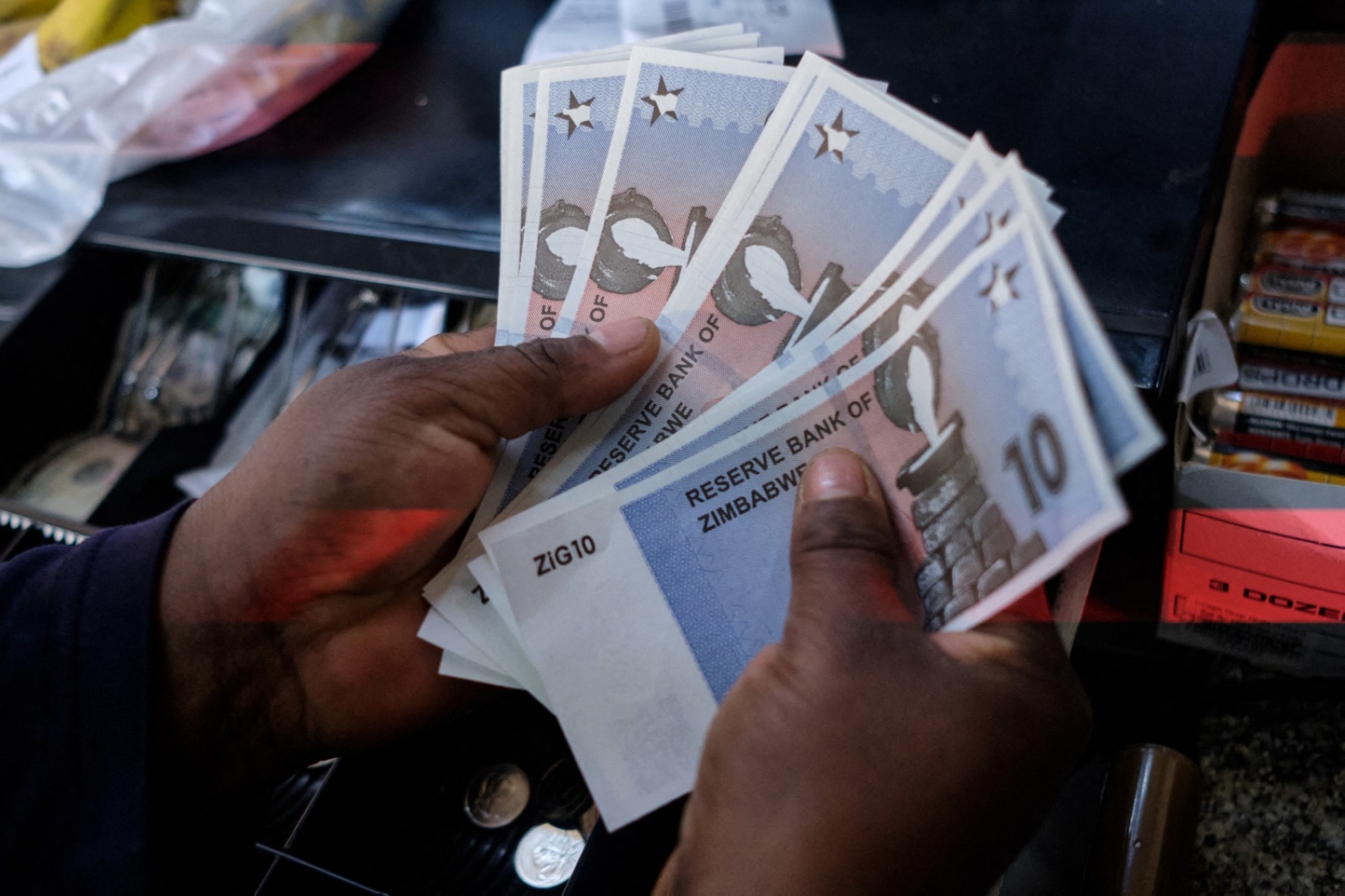
A cashier in a leading supermarket dispenses the new $10 ZiG, short for Zimbabwe Gold, note from a till as change in Harare on 30 April 2024.

Paradoxically, the dollar continues to strengthen even in countries whose governments publicly oppose American dominance. This happens not only because of the strength of the US economy, but because the dollar rests upon a vast global architecture of trust. It accounts for 58-59% of global foreign exchange reserves, appears in around 88-90% of foreign exchange transactions worldwide, and remains the principal currency used in pricing global trade and energy.

An estimated 60% of all US banknotes in circulation are held outside the United States. In many parts of the world, the dollar is effectively the unofficial local currency. Its strength comes from the institutions, policies, and capabilities behind it: the Federal Reserve, deep American financial markets, the legal system, freedom of capital movement, and the political and military power of the United States.

China, despite its immense economic strength, lacks many of these institutional advantages. This is one reason why the yuan has yet to emerge as a genuine global alternative to the dollar. Dollar dominance grants Washington extraordinary privileges. The world does not merely use dollars; it stores dollar reserves and buys US Treasury bonds with them, effectively financing America’s deficits.

This gives the United States financial and geopolitical leverage unmatched by any other power, and therein lies a striking irony: American sanctions intended to weaken Washington’s adversaries often end up boosting demand for the dollar itself. In countries such as Venezuela, Syria, and Iran, sanctions, instability, and restrictions mean people hoard dollars bought on black markets.

REUTERS/Mohamed Azakir
REUTERS/Mohamed AzakirREUTERS/Mohamed Azakir A money exchange vendor counts US dollar banknotes at his shop in Beirut, Lebanon, on 19 January 2023.

Dollar pegging

Lebanon may be the clearest Arab example of this phenomenon, but it is far from alone. Across the Arab world, economies exist to varying degrees within the dollar’s orbit. Most Arab Gulf states have pegged their currencies to the dollar for decades, while Kuwait operates a currency basket in which the dollar carries significant weight. Iraq’s oil revenues, denominated in dollars, pass through American accounts before being channelled back into the Iraqi economy through Iraq’s central bank.

Egypt experiences repeated waves of dollar hoarding whenever the Egyptian pound comes under pressure. Syria and Libya, meanwhile, operate multi-currency economies in which local currencies coexist with the dollar and other foreign currencies. This is not merely psychological; many Arab economies are rentier or semi-rentier systems dependent on oil, remittances, tourism, foreign aid, or imports, all of which are deeply tied to the dollar. In such economies, the dollar becomes embedded in the economic structure long before any crisis erupts. During crises, it then becomes a refuge.

The post Why people flock to the dollar when local currencies collapse appeared first on The Zimbabwe Mail.

50 Cent reunites Power icons for ‘Power: Legacy’ in biggest franchise expansion yet

Curtis “50 Cent” Jackson is once again reshaping the television landscape, greenlighting what is being described as the most ambitious chapter in the Power universe to date. The new series, Power: Legacy, will bring together fan-favourite characters Tommy Egan and Tariq St. Patrick in a long-anticipated reunion set against the backdrop of New York City’s […]

The post 50 Cent reunites Power icons for ‘Power: Legacy’ in biggest franchise expansion yet appeared first on The Zimbabwe Mail.

Curtis “50 Cent” Jackson is once again reshaping the television landscape, greenlighting what is being described as the most ambitious chapter in the Power universe to date. The new series, Power: Legacy, will bring together fan-favourite characters Tommy Egan and Tariq St. Patrick in a long-anticipated reunion set against the backdrop of New York City’s criminal underworld.

According to entertainment outlet AllHipHop.com, “50 Cent just greenlit ‘Power: Legacy’ with Joseph Sikora and Michael Rainey Jr. bringing Tommy and Tariq back together for a New York takeover,” marking a major crossover moment in one of television’s most commercially successful modern franchises.

The series sees Power: Legacy positioned as a pivotal expansion of the wider Power universe, which has grown into a multi-series storytelling ecosystem spanning more than a decade.

Joseph Sikora returns as the volatile and unpredictable Tommy Egan, while Michael Rainey Jr. reprises his role as Tariq St. Patrick, the ambitious heir to the original series’ legacy. Their reunion signals the first time two major lead characters from different Power spin-offs will share a central storyline.

Speaking about the project, 50 Cent told The Hollywood Reporter: “Power never dies, and this chapter is our biggest yet. Fans have been waiting to see Tariq and Tommy together, and now they’re taking over New York City. Bringing Joseph and Michael back together is special; they’ve turned these characters into true icons of the Power universe.”

The scale of the franchise’s success provides context for the significance of this new chapter. The Power universe has reportedly accumulated more than two billion hours of global viewership, cementing its status as one of the most influential television brands in contemporary streaming-era entertainment.

The most recent instalment, Power Book IV: Force, further demonstrated the franchise’s commercial durability, drawing approximately nine million multiplatform viewers on its premiere and recording strong in-season growth, reflecting sustained audience demand across its expanding narrative universe.

A franchise built like a cinematic universe

The Power franchise has evolved into a structured television universe comparable to major cinematic franchises, with interconnected storylines and character crossovers forming its narrative backbone.

The original series, Power, launched the franchise and introduced viewers to the world of James “Ghost” St. Patrick and his complex double life between legitimate business and organised crime.

It was followed by multiple spin-offs, including Power Book II: Ghost, which centred on Tariq’s attempt to navigate academia and criminal enterprise; Power Book III: Raising Kanan, which explored the origins of Kanan Stark; and Power Book IV: Force, which followed Tommy Egan’s relocation to Chicago.

A prequel project, Power Origins, is also currently in production in New York, further expanding the franchise’s generational storytelling structure.

Industry analysts note that Power: Legacy represents the first strategic convergence of two flagship spin-off leads, signalling a shift from parallel storytelling into fully integrated narrative crossover architecture.

50 Cent’s expanding entertainment empire

Beyond the screen, 50 Cent’s influence in the entertainment industry continues to expand through his production infrastructure. His G-Unit Film & Television Studios in Shreveport, Louisiana, has become a significant production hub, backed by a long-term lease and substantial investment that has positioned it among the largest Black-owned studio operations in the United States.

The studio’s expansion reflects a broader strategy of vertical integration—where content creation, production, and distribution ecosystems are consolidated under a unified creative and commercial vision.

A franchise still in growth mode

What makes the announcement of Power: Legacy particularly notable is not just nostalgia, but commercial momentum. Few television franchises maintain multi-year relevance while continuously expanding character arcs, production scale, and global audience reach.

In the increasingly competitive streaming landscape, Power has managed to sustain itself through a combination of character-driven storytelling, strategic spin-offs, and consistent reinvention of its narrative universe.

With Tommy Egan and Tariq St. Patrick now set to share the screen, Power: Legacy appears positioned not merely as another spin-off, but as a consolidation point for one of television’s most enduring modern crime dramas—and a reminder that, in 50 Cent’s words, “Power never dies.”

The post 50 Cent reunites Power icons for ‘Power: Legacy’ in biggest franchise expansion yet appeared first on The Zimbabwe Mail.

Integrated Marketing Analytics as a Growth Engine: A Critical Review in the Context of Zimbabwe’s Evolving Corporate Landscape

IN today’s data-saturated business environment, marketing is no longer a purely creative discipline driven by intuition, branding instinct, or historical spending patterns. It has increasingly become a quantitative science shaped by analytics, behavioural modelling, and real-time optimisation. Yet despite the proliferation of tools, dashboards, and platforms, many organisations remain trapped in a paradox of choice: […]

The post Integrated Marketing Analytics as a Growth Engine: A Critical Review in the Context of Zimbabwe’s Evolving Corporate Landscape appeared first on The Zimbabwe Mail.

IN today’s data-saturated business environment, marketing is no longer a purely creative discipline driven by intuition, branding instinct, or historical spending patterns. It has increasingly become a quantitative science shaped by analytics, behavioural modelling, and real-time optimisation. Yet despite the proliferation of tools, dashboards, and platforms, many organisations remain trapped in a paradox of choice: they possess more data than ever before, but struggle to convert it into coherent growth strategies.

By Brighton Musonza

This tension is particularly visible in emerging economies such as Zimbabwe, where firms are simultaneously grappling with constrained marketing budgets, fragmented consumer data, informal market dominance, and rapidly evolving digital ecosystems driven by mobile money and social media platforms.

Against this backdrop, the central question is not whether marketing analytics matters, but whether organisations are structurally and intellectually prepared to integrate it into decision-making systems that drive sustained growth.

The Analytics Paradox: Too Many Tools, Too Little Integration

Across global markets, companies have invested heavily in advanced marketing analytics capabilities, ranging from marketing-mix modelling (MMM) and attribution systems to AI-driven predictive analytics. However, rather than simplifying decision-making, this expansion has often created fragmentation.

Large multinational firms such as Procter & Gamble, Unilever, and Coca-Cola have all invested in sophisticated analytics ecosystems, yet even these organisations have acknowledged the difficulty of integrating multiple models into a single coherent view of performance. The result is often organisational paralysis, where different teams rely on different tools, each producing contradictory “truths” about what drives growth.

In Zimbabwe, this fragmentation is amplified by structural constraints. Many firms rely heavily on basic sales tracking, social media engagement metrics, and periodic market research reports. Advanced modelling systems such as MMM or algorithmic attribution remain rare, not because they lack value, but because data continuity, technical expertise, and system integration are still developing.

This creates a tendency toward oversimplification, where marketing decisions are driven by either historical budget allocation or short-term sales spikes rather than integrated performance logic.

Marketing ROI in Zimbabwe: The Hidden Inefficiency in Spend Allocation

One of the most significant insights from global marketing analytics research is that organisations using integrated models can unlock between 15 and 20 percent of wasted or misallocated marketing spend. This is not achieved by reducing marketing activity, but by reallocating it more intelligently across channels, time horizons, and consumer segments.

In Zimbabwe, where corporate margins are often compressed by inflationary pressures, currency fluctuations, and import dependency, this inefficiency carries even greater weight. Marketing budgets are frequently treated as fixed overheads rather than dynamic investment portfolios.

Telecommunications companies such as Econet Wireless Zimbabwe have demonstrated more advanced use of data-driven marketing, particularly in mobile money ecosystems, where customer behaviour is tracked in real time through transaction data. However, many sectors, including FMCG, retail, and agriculture, still rely heavily on traditional advertising channels without robust attribution systems linking spend to measurable behavioural outcomes.

This gap between spend and measurable return represents one of the most under-optimised areas of corporate performance in the Zimbabwean economy.

Anchoring Marketing Analytics to Strategy, Not Activity

A recurring failure in marketing systems globally is the absence of strategic anchoring. Without a clear strategic framework, marketing spend becomes reactive rather than intentional, often driven by last year’s budget allocations or internal departmental influence rather than long-term value creation.

Global corporations such as Amazon and Apple avoid this trap by linking marketing investment directly to ecosystem expansion and customer lifetime value rather than short-term campaign performance. In contrast, many firms in emerging markets still evaluate marketing success primarily through immediate sales conversion, ignoring long-term brand equity effects.

In Zimbabwe, this short-term bias is reinforced by macroeconomic volatility. When inflation accelerates or liquidity tightens, firms naturally shift toward immediate revenue-generating campaigns. However, this approach risks undermining brand development, particularly in competitive sectors such as banking, telecoms, and fast-moving consumer goods.

A more robust approach would require Zimbabwean firms to evaluate marketing investments through multi-layered lenses that include strategic value, economic return, and time horizon alignment, rather than purely transactional metrics.

The Consumer Decision Journey in a Digitally Fragmented Market

Traditional marketing theory often relied on linear models such as the “marketing funnel,” which assumed predictable consumer movement from awareness to purchase. However, global consumer behaviour has shifted toward a non-linear decision journey shaped by peer influence, digital platforms, and real-time comparison.

Companies such as Google, Meta, and Alibaba have built entire ecosystems around this non-linear behaviour, capturing micro-interactions that signal intent long before purchase decisions occur.

In Zimbabwe, this shift is even more pronounced due to the dominance of mobile-first consumption behaviour. Platforms such as WhatsApp, Facebook, and TikTok increasingly function as both discovery and transaction channels, particularly in informal retail ecosystems.

For example, informal traders in Harare and Bulawayo frequently rely on WhatsApp groups for product marketing, price negotiation, and customer engagement, effectively bypassing traditional advertising channels altogether. This creates a fragmented data environment where consumer behaviour is visible but not systematically captured.

Without integrated analytics systems, firms risk misunderstanding where value is actually created in the consumer journey.

Marketing-Mix Modelling, Attribution, and the Limits of Single-Lens Thinking

Globally, three dominant analytical frameworks shape marketing decision-making. Marketing-mix modelling (MMM) helps organisations understand long-term spend efficiency across channels. Attribution modelling focuses on digital touchpoints and conversion paths. Heuristic models such as reach-cost-quality (RCQ) provide simplified comparative frameworks where data is limited.

Each model has strengths, but also structural limitations when used in isolation.

Multinational companies such as Nestlé and Unilever have increasingly moved toward hybrid systems that combine MMM with real-time attribution and consumer analytics. This allows them to balance short-term performance optimisation with long-term brand investment.

In Zimbabwe, however, most firms implicitly rely on a single method—often basic sales correlation or digital engagement metrics. This creates distorted decision-making, particularly when short-term performance channels such as social media advertising appear more efficient than long-term brand-building channels such as television or sponsorships.

A key risk in this environment is over-allocation to performance marketing at the expense of brand equity, a pattern already observed in several emerging markets where digital advertising growth has outpaced strategic integration.

The Short-Term Trap: A Structural Risk for Emerging Markets

One of the most consistent findings in global marketing science is that short-term performance metrics often overstate their importance relative to long-term brand effects. While digital campaigns may deliver immediate conversions, brand-building investments contribute significantly to sustained revenue over time.

A classic example is seen in consumer goods companies that shifted heavily into digital performance marketing only to later discover that long-term brand recall and pricing power had eroded.

In Zimbabwe, this risk is amplified by budget constraints. Firms naturally gravitate toward channels that deliver immediate measurable returns, often neglecting long-term brand investments such as consistent storytelling, regional positioning, and emotional branding.

However, regional examples such as South Africa’s Nando’s demonstrate the power of integrated marketing. By combining bold creative branding with consistent multi-channel analytics-driven optimisation, the company has achieved both cultural relevance and commercial expansion across multiple markets.

Organisational Integration: The Missing Link in Zimbabwean Marketing Systems

Perhaps the most critical barrier to effective marketing analytics is not technological but organisational. Globally, companies that succeed in integrating analytics into growth strategies treat data teams, marketing teams, and executive leadership as a unified decision-making ecosystem.

Financial services firms such as Standard Bank Group and FirstRand have increasingly adopted cross-functional “analytics councils” that bring together data scientists, marketers, and strategists to ensure alignment between insight generation and execution.

In Zimbabwe, organisational silos remain a major constraint. Marketing teams often operate separately from data or finance departments, limiting the ability to build feedback loops that continuously refine campaign effectiveness.

Without institutional integration, even the most advanced analytics tools fail to generate meaningful business impact.

The Future of Marketing Analytics in Zimbabwe: From Reporting to Prediction

The next phase of marketing evolution in Zimbabwe will likely be defined by the transition from descriptive analytics to predictive and prescriptive systems. Artificial intelligence, machine learning, and mobile data ecosystems will increasingly enable firms to anticipate consumer behaviour rather than simply respond to it.

Fintech platforms such as EcoCash have already demonstrated how transactional data can be used to model consumer behaviour at scale. The next step will be extending this logic into retail, agriculture, banking, and even public sector communication systems.

However, this transition will require investment not only in technology but in analytical literacy, data infrastructure, and governance frameworks that ensure data is used strategically rather than tactically.

Conclusion: From Fragmented Insight to Integrated Growth Systems

The central lesson from global marketing analytics is clear: the problem is no longer a lack of data, but a lack of integration. Organisations that succeed in converting analytics into growth are those that connect strategy, modelling, and execution into a unified system.

For Zimbabwean firms, this presents both a challenge and an opportunity. The challenge lies in overcoming structural constraints such as data fragmentation, limited technical capacity, and short-term financial pressures. The opportunity lies in leapfrogging traditional marketing systems by adopting integrated analytics frameworks from the outset.

Ultimately, marketing analytics is not about choosing the right tool. It is about building the organisational intelligence to use multiple tools together, in a way that aligns insight with strategy and transforms information into sustained competitive advantage.

The post Integrated Marketing Analytics as a Growth Engine: A Critical Review in the Context of Zimbabwe’s Evolving Corporate Landscape appeared first on The Zimbabwe Mail.