IS YOUR MONEY SAFE?! EcoCash HACKER Unleashes Explicit Rant and Pornographic Content on Their Twitter Account Over $35

EcoCash Twitter Account Hack: A Digital Wake-Up Call for Zimbabwe’s Mobile Money? The recent compromise of EcoCash’s official X (formerly Twitter) account has sent ripples across Zimbabwe’s digital landscape, igniting critical questions about cyb…

EcoCash Twitter Account Hack: A Digital Wake-Up Call for Zimbabwe’s Mobile Money? The recent compromise of EcoCash’s official X (formerly Twitter) account has sent ripples across Zimbabwe’s digital landscape, igniting critical questions about cybersecurity within the nation’s dominant mobile money platform. The incident, which saw a hacker claiming an unreimbursed US$35 loss, briefly transformed a […]

The post IS YOUR MONEY SAFE?! EcoCash HACKER Unleashes Explicit Rant and Pornographic Content on Their Twitter Account Over $35 first appeared on My Zimbabwe News.

Minister Mutsvangwa commends SMEs contribution in Mat North

Source: Minister Mutsvangwa commends SMEs contribution in Mat North – herald Business Reporter Women Affairs, Community, Small and Medium Enterprises Development Minister Senator Monica Mutsvangwa has commended small and medium enterprises in Matabeleland North for driving community economic growth, saying their work aligns with the Government’s devolution agenda and Heritage-based Education 5.0. Speaking during the […]

The post Minister Mutsvangwa commends SMEs contribution in Mat North appeared first on Zimbabwe Situation.

Source: Minister Mutsvangwa commends SMEs contribution in Mat North – herald

Business Reporter

Women Affairs, Community, Small and Medium Enterprises Development Minister Senator Monica Mutsvangwa has commended small and medium enterprises in Matabeleland North for driving community economic growth, saying their work aligns with the Government’s devolution agenda and Heritage-based Education 5.0.

Speaking during the International Day of Families commemorations, which ran concurrently with a business expo held in the province recently, the minister said she visits Matabeleland North every June to assess SME progress.

Minister Mutsvangwa highlighted the strong organisation among local business leaders and noted the return of Zimbabweans from the diaspora in South Africa and Botswana, who are reinvesting in their communities.

“The SMEs are very organised; the leadership of SMEs is very organised throughout the country, but in particular in Matabeleland North,” Senator Mutsvangwa said.

She cited sectors such as timber, tourism, handicrafts and farming as areas where the province is excelling.

The minister credited Government infrastructure projects for supporting SME growth.

She cited the Gwayi-Shangani Dam and the ongoing rehabilitation of the Bulawayo to Victoria Falls Road as critical to transforming livelihoods.

“A road is an economy and the Government is very serious about that,” she said.

Minister Mutsvangwa said the Second Republic’s decentralisation policy meant national events were now being held outside Harare to spread development.

She added that her ministry’s mandate is to promote communities and SMEs across all provinces by replicating best practices from Mat North to Manicaland, Mash East and Mash West.

On education, the minister commended school children for showcasing prototypes at the event, linking their innovation to the rollout of Heritage-based Education 5.0.

“Zimbabweans are raring to go. There’s no way we can’t reach Vision 2030,” she stated, reiterating President Mnangagwa’s goal of a middle-income society.

She urged SMEs to remain inclusive and reach grassroots communities, saying families that put food on the table and send children to school are key to tackling drug and substance abuse.

SMEs are the backbone of Zimbabwe’s economy, making up 90 percent of all businesses and contributing over 60 percent of the nation’s Gross Domestic Product.

The sector drives national employment, supporting millions of livelihoods across diverse industries such as manufacturing, retail, agriculture, and services

Meanwhile, with this year’s International Day of Families theme focused on families, inequalities and children’s well-being, Senator Mutsvangwa called for protection of children and an end to child marriage and gender-based violence.

“Let them fly. Girls, boys, they can fly,” she said.

The post Minister Mutsvangwa commends SMEs contribution in Mat North appeared first on Zimbabwe Situation.

Zim firms eye Zambia agric, construction services markets

Source: Zim firms eye Zambia agric, construction services markets – herald Michael Tome Business Reporter Zimbabwean companies in the agriculture and construction service sectors will next week explore new business opportunities in Zambia, as the country bids to grow exports and deepen regional trade. More than 30 local companies will participate in a Services Business […]

The post Zim firms eye Zambia agric, construction services markets appeared first on Zimbabwe Situation.

Source: Zim firms eye Zambia agric, construction services markets – herald

Michael Tome

Business Reporter

Zimbabwean companies in the agriculture and construction service sectors will next week explore new business opportunities in Zambia, as the country bids to grow exports and deepen regional trade.

More than 30 local companies will participate in a Services Business Mission to Zambia from June 09-11, in Lusaka, in an initiative organised by ZimTrade.

The mission, to be hosted at the InterContinental Hotel in Lusaka, will bring together Zimbabwean service providers and potential Zambian buyers, investors and business partners.

It aims to generate export orders, forge strategic partnerships and expand Zimbabwe’s footprint in regional value chains.

The programme targets export-ready firms operating in agriculture services and building and construction-related services, including small and medium enterprises as well as women and youth-led businesses.

The initiative follows an exploration mission conducted by ZimTrade last year, which identified significant opportunities for Zimbabwean companies in Zambia’s growing construction and infrastructure sectors.

Building on those findings, the agency has broadened the scope of the programme to include agriculture services as part of efforts to diversify Zimbabwe’s export basket and increase participation in regional services trade.

Under its Vision 2030 economic blueprint, Zimbabwe targets annual export earnings of US$14 billion.

To achieve this, the country aims for a minimum annual export growth of 10 percent for goods and 15 percent for services, shifting from raw commodities to value-added products.

ZimTrade chief executive officer, Mr Allan Majuru, said the mission aligns with national efforts to boost services exports, strengthen regional economic integration and support Zimbabwe’s export-led growth agenda.

“This initiative reflects Zimbabwe’s broader objective of increasing services exports and positioning local companies to play a bigger role in regional value chains.

“As the country advances industrialisation and export-led growth under Vision 2030, markets such as Zambia provide an important platform for Zimbabwean firms to commercialise their expertise, expand their regional footprint and generate foreign currency earnings,” said Mr Majuru.

He noted that Zimbabwe has developed strong capabilities in agriculture and construction-related services, creating opportunities for local firms to compete beyond the domestic market.

“Our focus is to create sustainable export opportunities that support business growth, job creation and greater participation of women- and youth-led enterprises in international trade.

“Zambia offers a strategic gateway into the wider Southern African market and this mission is designed to help local companies convert regional demand into long-term commercial partnerships,” he said

The business mission comes at a time when Zimbabwe is increasingly seeking to leverage services exports as a source of foreign currency earnings and economic diversification.

Commodities and manufactured goods currently dominate Zimbabwe’s export basket.

Authorities have since identified engineering, construction, agricultural consultancy and technical support services as areas with significant export potential.

During the three-day programme, participating companies will engage in business-to-business meetings, market engagement sessions and networking events designed to facilitate commercial agreements and market entry opportunities.

ZimTrade said that the platform will provide a platform for matchmaking and on-the-ground support to help companies connect with prospective clients and partners.

The trade promotion agency expects the mission to generate new business leads, provide valuable market intelligence on Zambia’s services sector and contribute to the diversification of Zimbabwe’s exports.

Zambia’s expanding infrastructure projects, growing agricultural sector and rising demand for specialised professional services make it an attractive destination for Zimbabwean exporters seeking regional growth opportunities.

Zimbabwe and Zambia have strong bilateral trade relations, with cross-border commerce benefiting from geographic proximity and shared membership in regional economic blocs.

The business mission is expected to strengthen economic cooperation between the two countries and open new avenues for Zimbabwean exporters to access opportunities across Southern Africa.

This initiative also shows the growing importance of services trade in regional economic development, as countries look beyond traditional goods exports to drive growth, employment creation and foreign currency generation.

The post Zim firms eye Zambia agric, construction services markets appeared first on Zimbabwe Situation.

Econet’s DPA targets 50MW solar energy boost in Harare

Source: Econet’s DPA targets 50MW solar energy boost in Harare – herald Business Reporter ECONET InfraCo, through its renewable energy arm Distributed Power Africa, is scaling up its clean energy investments after applying for a licence to construct a 50-megawatt solar plant in Harare. The utility-scale project marks a significant expansion for the newly restructured, […]

The post Econet’s DPA targets 50MW solar energy boost in Harare appeared first on Zimbabwe Situation.

Source: Econet’s DPA targets 50MW solar energy boost in Harare – herald

Business Reporter

ECONET InfraCo, through its renewable energy arm Distributed Power Africa, is scaling up its clean energy investments after applying for a licence to construct a 50-megawatt solar plant in Harare.

The utility-scale project marks a significant expansion for the newly restructured, Victoria Falls Stock Exchange-listed infrastructure giant as it aggressively builds out its independent green energy capacity.

The application has been lodged with the Zimbabwe Energy Regulatory Authority (ZERA).

According to a public notice issued by Victoria Falls Stock Exchange-listed Econet InfraCo, the proposed solar project will be located at Godavery Farm in the Hatfield suburb of the capital.

DPA is a leading pan-African renewable energy company specialising in solar energy solutions for commercial, industrial and telecommunications customers.

It was originally built on Econet Wireless Zimbabwe’s extensive experience operating power systems and battery backups for its mobile network base stations.

Currently, DPA manages critical energy infrastructure across several African nations, including South Africa, Kenya, Zambia and the Democratic Republic of Congo.

Locally, its prominent commercial footprint includes major industrial installations such as the 1MW Schweppes Zimbabwe rooftop plant in Willowvale, a 1,8MW hybrid facility at Tanganda Tea’s Ratelshoek Estate in Chipinge and various green energy projects for corporate clients like Delta Corporation and Stanbic Bank.

“Distributed Power Africa intends to generate electricity from the proposed solar plant and supply its customers,” said Econet InfraCo.

The proposed 50MW Godavery Farm development marks a significant scale-up for DPA into large, utility-scale grid supply.

The investment transitions the company beyond its traditional “behind-the-meter” commercial and industrial installations towards directly feeding the national electricity grid.

DPA intends to utilise the electricity generated from the Godavery Farm facility to supply its growing commercial and industrial customer base.

The company would design and deploy tailor-made, engineered energy solutions that are customised to meet the specific customer requirements.

To integrate the new power source into the national network, the project will require a substantial infrastructure buildout, including the construction of a 132/33kV substation on-site at the farm.

The green energy project will connect to the grid through the construction of an approximately 9-kilometer, 132kV single “lynx” overhead transmission line.

This line will link the solar plant directly to a proposed new switching station situated along the existing Dema-Coleford 132kV transmission line.

As part of the statutory regulatory process, ZERA has opened a 14-day window for public consultations, allowing interested stakeholders and residents to weigh in on the utility project.

The proposed investment comes at a time when Zimbabwe is actively diversifying its energy mix away from traditional thermal and hydro dependency. 

Persistent climate-induced droughts have severely curtailed hydropower output at the Kariba Dam hydroelectric plant, while the country’s aging coal-fired plants at the Hwange thermal complex face recurrent operational bottlenecks.

In response, Government and private energy players are leaning heavily on solar energy, backed by Zimbabwe’s exceptional solar irradiation levels that average over 3 000 sunshine hours annually.

Under the National Development Strategy (NDS2) and the National Renewable Energy Policy, Zimbabwe is targeting 26,5 percent renewable energy penetration in the national grid mix.

While Independent Power Producers (IPPs) have historically developed smaller captive installations for internal corporate use, ZERA’s active licensing pipeline features dozens of huge new solar projects.

Major projects driving this transition include utility-scale inland initiatives like the Gwanda Solar Project (100MW), localised urban networks and proposed floating solar installations on Lake Kariba. 

ZERA has licensed nearly 171 Independent Power Producers (IPPs). However, funding and development challenges mean only about 48 are currently operational, while others remain at different stages of construction, feasibility, or funding.

The energy regulator has licensed numerous IPPs to bridge the national power deficit, of about 2 200MW at peak demand, attract private investment to bypass government financing constraints and diversify energy sources toward renewables.

Zimbabwe produces an average of 1 400MW, through State-owned hydro and thermal power stations, leaving a substantial gap for private players to plug the gap.

The post Econet’s DPA targets 50MW solar energy boost in Harare appeared first on Zimbabwe Situation.

Nearly 4 000 small-scale farmers trained in digital agric

Source: Nearly 4 000 small-scale farmers trained in digital agric – herald Theseus Mauruki Shambare in MHONDORO-NGEZI Nearly 4 000 small-scale farmers across Zimbabwe have been trained in digital farming under a Food and Agriculture Organisation project aimed at modernising agriculture and closing the digital gap between rural and urban areas The training programme, being […]

The post Nearly 4 000 small-scale farmers trained in digital agric appeared first on Zimbabwe Situation.

Source: Nearly 4 000 small-scale farmers trained in digital agric – herald

Theseus Mauruki Shambare in MHONDORO-NGEZI

Nearly 4 000 small-scale farmers across Zimbabwe have been trained in digital farming under a Food and Agriculture Organisation project aimed at modernising agriculture and closing the digital gap between rural and urban areas

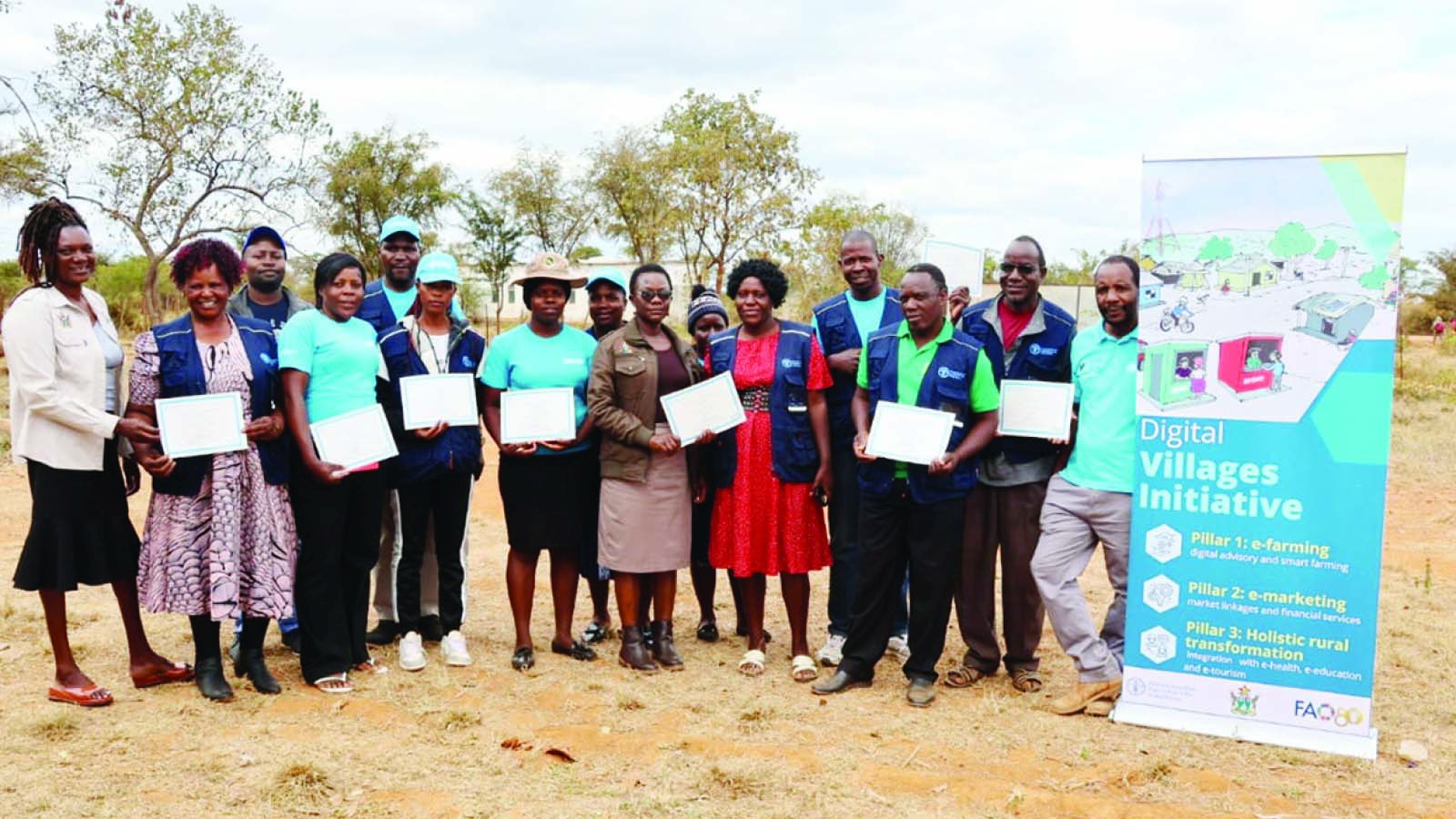
The training programme, being implemented under the Digital Villages Initiative (DVI), has so far reached 3 879 rural producers through digital agriculture literacy trainings in Mashonaland West and Masvingo provinces.

The initiative is being rolled out in Mhondoro-Ngezi District and Bikita District, where digital hubs have been established to provide free internet access, digital literacy training and technology-based agricultural advisory services.

The programme is part of a broader regional project covering Zimbabwe, Malawi and Rwanda titled Fostering Digital Villages Through Innovative Advisory and Profitable Market Services in Africa (FDiVi).

During a digital agriculture programme tour and the certificate handover ceremony in Mhondoro-Ngezi, recently, stakeholders revealed that the initiative sought to improve productivity, market access and information flow among rural farmers through technology-driven solutions.

Authorities said the project was targeting key challenges affecting rural communities, including weak adoption of digital agriculture technologies, limited internet access, youth unemployment and growing gender gaps in digital inclusion.

Addressing farmers during the tour, Fostering Digital Villages Through Innovative Advisory and Profitable Market Services in Africa (FDiVi) food security monitoring and digital agriculture specialist, Mr Dowsen Sango said the project was helping rural farmers integrate Artificial Intelligence (AI) and digital tools into everyday farming activities.

He said farmers were now using AI-powered platforms to identify crop diseases, detect livestock health problems and make informed production decisions by simply taking pictures using smartphones.

“We are moving agriculture from traditional guesswork to informed decision-making powered by technology. Farmers are now able to take pictures of diseased crops or sick animals using their phones and receive instant feedback and recommendations through AI-supported platforms,” said Mr Sango.

He said the initiative was also enabling farmers to use social media and digital marketplaces to source affordable agricultural inputs, compare prices and secure buyers before production.

“Digital agriculture is not only about production, but also profitability. Farmers are now linking directly with input suppliers, transporters and buyers through online platforms and social media groups. This allows them to compare prices, identify reliable suppliers and produce for ready markets,” he said.

Mhondoro-Ngezi District Agricultural Business Advisory Officer (ABAO) Ms Nola Marumbwa said the initiative was strengthening extension services by allowing farmers to access quicker, data-driven agricultural support while improving linkages between producers, suppliers and markets.

“We are seeing farmers becoming more confident in making farming decisions because information is now easily accessible through digital platforms. Instead of waiting for physical visits, farmers can quickly identify crop diseases, seek livestock health advice and interact with extension officers using smartphones and AI-supported applications,” said Ms Marumbwa.

She said digital platforms were also helping farmers become more market-oriented and business-focused.

“Many farmers are now using WhatsApp groups and online platforms to compare input prices, identify genuine suppliers and connect with buyers before production. This is helping communities reduce losses, improve planning and increase profitability,” she said.

Mr Sango said the programme was helping reduce exploitation by middlemen while improving access to agricultural knowledge in remote communities.

“We want rural farmers to participate competitively in modern value chains. Access to information is becoming as important as access to land and water. Through digitalisation, farmers are improving productivity, reducing losses and increasing incomes,” he said.

Under the programme, farmers are being introduced to mobile-based agricultural services, online market systems and Artificial Intelligence-enabled advisory platforms.

The initiative has also piloted AI-powered agricultural advisory services and trained agricultural extension specialists from 25 districts on the use of generative artificial intelligence tools in farming systems.

Government departments, local universities, private sector players and mobile network operators are working together under the initiative to strengthen digital transformation within rural agrifood systems.

Digital hubs established under the programme are operating through existing infrastructure, including ZimPost District Information Centres and AGRITEX Ward Information Centres.

Officials said the hubs were improving rural access to internet services, digital tools and agricultural information.

The programme has also introduced a “Digital Champions” model in which selected early adopters are trained and later assist communities in adopting digital farming technologies.

One of the farmers trained under the AI-supported agriculture programme, Ms Gladys Vakira, said the technology was changing how farmers handled crop and livestock management.

“Before this programme, if crops developed strange diseases or animals became sick, we had to wait for extension officers or rely on guesswork. Now we can take pictures using our phones and receive guidance through AI tools and digital platforms,” she said.

Ms Vakira said farmers were also benefiting from online business networks created through WhatsApp and other social media platforms.

“We are now connected to suppliers and buyers through digital groups. Farmers are sharing information on seed prices, chemicals, feeds and available markets every day. This helps us buy cheaper products and plan production based on available markets,” she said.

Another beneficiary, Mr Tauya Nyangwaira, said the training had exposed farmers to modern agricultural business practices.

“We have learnt that farming today is no longer just about producing crops, but understanding markets and using information correctly. Through social media and digital platforms, we are now able to look for customers before harvesting,” he said.

Mr Nyangwaira said younger farmers were showing growing interest in agriculture because of the integration of technology and innovation.

“When young people see farmers using smartphones, internet platforms and AI tools in agriculture, they begin to appreciate farming as a modern business with opportunities for growth and income generation,” he said.

The programme has further established digital fairs bringing together rural farmers, agri-entrepreneurs and technology service providers to facilitate interaction and adoption of digital services.


The post Nearly 4 000 small-scale farmers trained in digital agric appeared first on Zimbabwe Situation.