Source: Chamisa’s return raises questions -Newsday Zimbabwe
OPPOSITION politician Nelson Chamisa’s return to active politics has been dismissed as a “massive distraction” during a critical moment for Zimbabwe’s controversial constitutional amendments.
The claims gain weight given his turbulent history as an opposition figure, marked by organisational failure and a pattern of retreat.
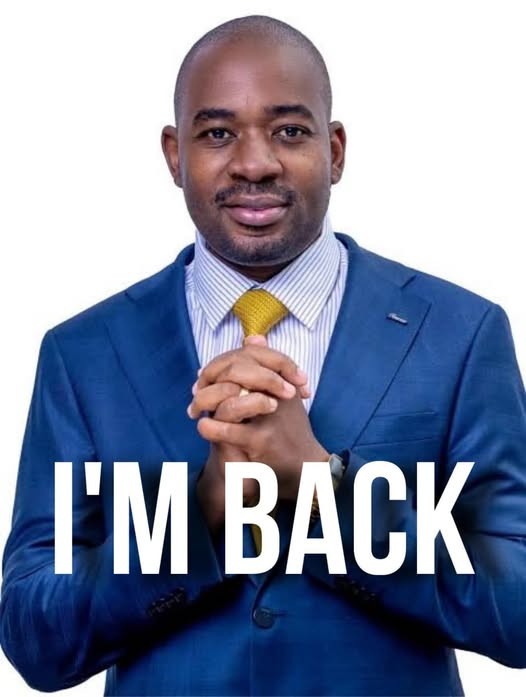
The former Citizens Coalition for Change (CCC) leader yesterday posted on X (formerly Twitter), promising “a whole new citizens movement and a new citizens government”.
“The new… new ways, new strategies, new tactics, new voices and new faces. A whole new citizens movement and a new citizens government,” he posted. Critics said this was a familiar refrain that has become something of a cycle for the opposition politician.
Since abruptly quitting the CCC in early 2024 after the party was hijacked by rival Sengezo Tshabangu — a move that sparked fierce internal factional battles — Chamisa has repeatedly used his social media platform to dangle visions of transformation.
Yet critics point to a glaring disconnect where his digital declarations rarely translate to tangible political infrastructure.
“From his MDC days through to the CCC, his leadership has been characterised by a reliance on personality over institutions,” one observer said.
The timing of Chamisa’s latest proclamation has drawn particular scrutiny from analysts.
As Parliament pushed through Constitution Amendment No 3 Bill (CAB 3), which seeks to extend President Emmerson Mnangagwa’s term expiry from 2028 to 2030, Chamisa remained largely silent.
The Bill secured a two-thirds majority in the National Assembly and was remitted to the Senate.
Chamisa’s fondness for posting Bible verses, often with cryptic captions, has earned him both devotion and derision.
His followers have repeatedly accused him of selling false hope, pointing to ambiguous promises that never materialise into coalitions, street movements or clear political strategies.
“What we are witnessing is simply a continuation of the same ‘strategic ambiguity’ and endless false starts that have characterised his politics since 2023,” analyst Ruben Mbofana said.
“We are once again being promised a ground-shaking new direction, yet it remains completely devoid of actionable substance or a clear roadmap”.
As CAB 3 advances and Zimbabwe’s political temperature rises, critics argue that the country cannot afford another cycle of Chamisa’s ambiguous promises. Mbofana went further, framing Chamisa’s tactics as inadvertently beneficial to the status quo by keeping the populace docile.
“In this context, his return does, indeed, act as a massive distraction. It creates a false sense of hope that someone else is handling the crisis behind closed doors, which neutralises the organic anger of the people and stops them from organising on the ground,” he added.
“When the opposition’s strategy consists only of social media hashtags and cryptic promises while the regime systematically rewrites the Constitution, they cease to be a resistance and effectively become complicit in maintaining the status quo”.
Mbofana said without a courageous programme of action, Chamisa’s announcements are nothing more than a safety valve that “blows out the steam of those who are genuinely trying to fight the system”.
Analyst Rashweat Mukundu echoed similar sentiments.
“Announcements on social media that are not accompanied by action tend to be performative and will soon fizzle out and be forgotten,” he said.
“The opposition base is looking for action and impact on the ground, not another tweet.”
Netizens were also swift to mock Chamisa’s announcement.
Mukundu, however, acknowledged that Chamisa retains a residual following and name recognition.
“Chamisa remains a key political figure in Zimbabwe, though diminished in terms of influence and organisational capacity to be a change agent,” he said.
“His comeback will make more meaning in terms of the leadership he puts in place to support him and action programmes on the ground.”
A lawyer and a pastor, Chamisa was President Emmerson Mnangagwa’s most formidable opponent in the 2018 and 2023 elections.
He took over the reins in the opposition from Morgan Tsvangirai, who died in 2019 while still leader of the MDC Alliance.
Chamisa was ousted by Douglas Mwonzora, who won controversial court judgments that declared the youthful politician’s rise to the MDC Alliance leadership unconstitutional.
He is over three decades younger than the 83-year-old Mnangagwa and his youthfulness was a major issue in the previous elections.
At least 62% of the Zimbabwean population is under 25.
These young people have no connection with the liberation war and are frustrated by lack of opportunities in the economy.
The post Chamisa’s return raises questions appeared first on Zimbabwe Situation.