Mwonzora to write to Chamisa to hand over MDC assets: If he chooses not to comply we will force him

MDC-T secretary-general Douglas Mwonzora says he will work to reorganize the party’s social base under acting president Thokozani Khupe but their first port of call is to write to Nelson Chamisa to implore him to hand-over party assets. This come…

MDC-T secretary-general Douglas Mwonzora says he will work to reorganize the party’s social base under acting president Thokozani Khupe but their first port of call is to write to Nelson Chamisa to implore him to hand-over party assets. This comes after the Supreme Court on Tuesday nullified Chamisa’s appointment as the leader of the opposition […]

Government intensifies smart agriculture

Source: Government intensifies smart agriculture | Herald (Top Stories) smart agriculture Martin Kadzere The Government has said it will intensify climate smart agriculture, a farming technique that helps farmers to be more productive on a warming planet, than adopting “harmful” genetically modified crops. This comes against the backdrop of growing calls by Genetically Modified Organisms […]

The post Government intensifies smart agriculture appeared first on Zimbabwe Situation.

Source: Government intensifies smart agriculture | Herald (Top Stories)

smart agriculture

Martin Kadzere

The Government has said it will intensify climate smart agriculture, a farming technique that helps farmers to be more productive on a warming planet, than adopting “harmful” genetically modified crops.

This comes against the backdrop of growing calls by Genetically Modified Organisms (GMOs) advocates pushing for the Government to adopt a policy that embrace the GM technology in light of successive failed harvests due to droughts linked to climate change.

Those actively campaigning for the GMOs are also arguing that the country is already consuming imported GMOs while maintaining the GM non-use policy was making the country’s agricultural produce uncompetitive.

Zimbabwe is facing a second successive drought resulting from the devastating effects of climate change with 5,8 million people, mainly from rural areas facing severe levels of food insecurity, according to the World Food Programme.

Lands, Agriculture, Water, Climate and Rural Resettlement Minister Perrance Shiri said yesterday that the Government’s position on the non-use of GMO materials would remain in place.

“We haven’t embraced the use of the GMOs as yet,” said Minister Shiri in an interview.

“The starting point is analysing and highlighting the implications of using the GMOs. Of course, we can talk of higher yields while ignoring implications on issues to do with health and environment in the long term. We do agree that we are faced with the devastating effects of climate change but as Government, we have decided to adopt smart farming, which does not include the production of the genetically modified materials.”

Many countries that have banned the GMOs including Zimbabwe argue that crop varieties will cross pollinate other plant and pollute environment, which could have long term effects for human health, according to reports. They have also argued that the crops will over time become susceptible to pest attacks.

However, the GMO defenders say claims on the implications on health and environment is not scientifically proven.

Minister Shiri said the Government would enhance the harvesting of water and use modern irrigation methods like drip irrigation, the type of technology which delivers small amount of water directly to plant roots, to counter the effect of climate change seen as a major threat to food security across the African continent.

Zimbabwe has more than 10 water bodies,  which are underutilised and the Government was looking at investing in irrigation infrastructure around these water sources.

“We have quite a number of water bodies in the country and we need to exploit them as a way of countering climate change,” said Minister Shiri.

“We are looking at developing irrigation schemes around them and I am sure this will boost yields than adopting the GMOs.”

Last year, National Biotechnology Authority Mr Dexter Savadye, said adoption of the GMOs was the way to go to enhance yields.

“I think it is the time to adopt these GMOs because of the state of national food security as well as to improve better yields,” said Mr Savadye.

“Actually we are consuming the GMOs and I think it is ideal to start engaging now.

“We have neighbouring countries namely South Africa and Botswana that are already consuming these. As a country we much not be left behind.”

Said principal research economist in the department of research services Mr Freeman Gutsa: “Zimbabwe cannot think of growing GMOs right now because we have potential that has not been capitalised so far, because if we look at maize we have a national yield of  0,49 tonnes  per hectare when we have some farmers who are producing 21 tonnes per hectare.

“So as of now we cannot adopt GMOs but maximise on our potential, through maximum utilisation of dams and land,” said Mr Gutsa.

“Maize, wheat, soya and maize are our main crops if we are to talk about food security, we just have to improve our yields on those.”

However, Minister Shiri said apart from smart agriculture, the Government was also encouraging production of drought resistant traditional small grains like millet and sorghum.

“These are known to be drought resistant and can do well even with little rains. Climate change hasn’t gone to the extent of making these crops unviable,” said the minister.

The post Government intensifies smart agriculture appeared first on Zimbabwe Situation.

Editorial Comment: Zambezi flows: Good news in hard times

Source: Editorial Comment: Zambezi flows: Good news in hard times | Herald (Top Stories) Most of the water flowing in Lake Kariba, and for that matter over the Victoria Falls, does not come from Zimbabwe; a fair amount comes from north-western Zambia, but easily the most important source of water for both the Lake and […]

The post Editorial Comment: Zambezi flows: Good news in hard times appeared first on Zimbabwe Situation.

Source: Editorial Comment: Zambezi flows: Good news in hard times | Herald (Top Stories)

Most of the water flowing in Lake Kariba, and for that matter over the Victoria Falls, does not come from Zimbabwe; a fair amount comes from north-western Zambia, but easily the most important source of water for both the Lake and the Falls is south-eastern Angola, so the rainfall there is what is critical.

The news is good, or at least a lot better than last year.

The water coming into the Barotse flood plain in Zambia hit just over 5 000 cubic metres a second at the end of February, receded a bit and then started coming up again to a little over 4 500 cubic metres a second at the end of last week, and that was around six times what we were seeing on the same date last year and about two-and-a-quarter times the general average.

In fact, the flows are the highest for 20 years, according to the Zambezi River Authority (ZRA), the independent body that manages Kariba Dam and allocates water rations to Zesa and Zescom of Zambia.

It can take a bit of time for this seasonal flow of water to reach Victoria Falls and Lake Kariba, but now that the Barotse flood plains are full, it is flowing faster.

By the end of last week more than 10 times as much water was thus dropping over the Victoria Falls than on New Year’s Day, and almost four times as much as the same day last year, making a spectacular show and ensuring that when tourism resumes after the global coronavirus alert, our visitors are guaranteed their money’s worth.

That is important, considering the nonsense that was being written.

It must be remembered that even when flows are at their lowest, the Falls are still spectacular.

The Zambezi never dries up, and the Falls are never just left as basalt cliffs drying in the sun.

There is always quite a lot flowing over the Falls. At the very worst the Zambezi still dumps in the first gorge every hour twice as much water as Harare City Council manages to extract from all its supply dams and distribute to the city and its surrounding towns on a really good day down at the waterworks.

Today, the gorge is getting a good day’s supply of Harare water in just under two minutes.

So tourism is always safe, and right now it would be in good shape and when Covid-19 is beaten, or at least is so under control, there will be the usual spectacular attraction in Zimbabwe.

The Kariba news is both good and not so good. The lake is rising fairly fast as far more water flows in than the two power stations are using, with almost four times as much coming in as is going out.

So the lake rose almost a metre between New Year’s Day and the end of last week, and has risen a bit more since.

But it had been run down to close on one metre above the minimum operating level before the new season’s floods started flowing in and is only a little over two metres above that minimum level.

Even when the lake is at the minimum operating level for the power stations it holds a lot of water.

Kariba Dam has two functions. First it has to provide a drop for the water to convert potential energy to kinetic energy as it falls down from the inlets to the turbines.

And if the flows in the Zambezi were identical every day of the year, every year, then the size of the impounded lake would be immaterial.

But the Zambezi has a very large variation between high flow and low flow, and between good years and bad years.

So a really large lake is needed, and Lake Kariba is the largest storage dam in the world, although the combined power stations are not.

But only the top 13m of a full lake can be used for generation, and that is a lot of water, around 65 billion cubic metres, enough to supply greater Harare for 400 years at present rates.

Unfortunately, at the end of last week, despite the rise, there were only 9,63 billion cubic metres in the usable band, a little under 15 percent of the full lake although that had crept up to almost 16 percent by Monday, according to ZRA.

This time last year it was at 37 percent, although lake levels were already falling as we started eating into storage accumulated in good years, and kept falling all year.

So although ZRA, Zesa and Zescom are all breathing a little easier, the authority has maintained its allotted annual ration for 2020 at 22 billion cubic metres. So Zesa and Zescom can each, on average, generate 275 megawatts for a total of 550MW.

How they use their rations is their business.

The ration is tight because the authority wants to restore stored reserves, or at least bring levels up to something that ensures the Kariba stations could cope with a regional drought again.

So the two stations between them should be using just under 700 cubic metres a second. According to authority daily figures for March they were overdoing it, usually averaging a little over 900 cubic metres a second.

So regrettably at some stage they are going to have to cut back. We can hope that the management and financial reforms at Zesa will, when the cut backs are compulsory, have managed to get more units at Hwange Thermal up and running to take up the slack.

Implementing those reforms at Zesa rapidly now becomes even more urgent as imports will be tight since Eskom of South Africa is also in need of reform, has also been given a new professional management team to fix its mess, but has to cut back on generation as it catches up on a decade of bad maintenance.

The post Editorial Comment: Zambezi flows: Good news in hard times appeared first on Zimbabwe Situation.

Access Forex launches US$200k COVID-19 relief initiative

Source: Access Forex launches US$200k COVID-19 relief initiative | Newsday (News) Access Forex, a unit of Access Finance Zimbabwe has committed an initial US$200 000 to assist the most vulnerable segments society and communities across the country who are now reeling from the negative impact of drought and the global coronavirus pandemic. The recent drought, […]

The post Access Forex launches US$200k COVID-19 relief initiative appeared first on Zimbabwe Situation.

Source: Access Forex launches US$200k COVID-19 relief initiative | Newsday (News)

Access Forex, a unit of Access Finance Zimbabwe has committed an initial US$200 000 to assist the most vulnerable segments society and communities across the country who are now reeling from the negative impact of drought and the global coronavirus pandemic.

The recent drought, which has resulted in a food crisis in the country coupled with the economic slowdown, and the COVID-19 pandemic as well as the resultant subsequent lockdown have had debilitating effects on families and communities.

Access Forex, a bureau de change which provide remittance services for Zimbabweans in the Diaspora, mainly in the UK and South Africa, has taken the move to compliments efforts by the government and various other humanitarian organisations to help mitigate the devastating negative impact of dry weather conditions, the pandemic and economic downturn.

In partnership with churches and NGO community, as well as government, Access Forex will provide food aid in the form of hampers to the vulnerable and needy in the society.

“Since most Zimbabweans are currently unemployed and are largely surviving on informal sector activities, they have been badly exposed to this situation and need help to go through these times of adversity,” George Chirwa, the executive director of the firm said at the virtual launch of the initiative yesterday.

The intervention will begin in Harare, Bulawayo and Victoria Falls before being rolled out to the rest of the country.

“Access Forex is a Zimbabwean business and as such it has some corporate social responsibilities. We believe that local organisations and people can play a big role in resolving Zimbabwe’s current challenges. This initiative is our small way as a responsible corporate to citizens of supporting the $100 million fund recently announced by the Minister of Finance and Economic Development Hon. Prof. Mthuli Ncube. Government needs help form all of us to deal with these challenges,” Chirwa said.

He also challenged other corporates and Zimbabweans in the diaspora to join the effort, and contribute to the goal of committing US$1 million to serve those in need and help improve their lives.

While the initiative is primarily targeted at helping out people affected by COVID-19, it would also be used to help underprivileged communities going forward.

“Through such strong partnerships, vulnerable people across Zimbabwe will receive food aid as we try to mitigate the impact of these combined adversities,” said Chirwa.

The post Access Forex launches US$200k COVID-19 relief initiative appeared first on NewsDay Zimbabwe.

The post Access Forex launches US$200k COVID-19 relief initiative appeared first on Zimbabwe Situation.

SPECIAL FEATURE | Inside Zimbabwe’s lockdown

There is growing desperation and precious little hope of observing physical distancing, says Crecey Kuyedzwa. Source: SPECIAL FEATURE | Inside Zimbabwe’s lockdown | Fin24 Where bread is retailing at Z$40, up from Z$30 the previous day; where there hasn’t been water for months and there’s sporadic access to borehole water; where neighbourhoods have no power […]
The post SPECIAL FEATURE | Inside Zimbabwe’s lockdown appeared first on Zimbabwe Situation.

There is growing desperation and precious little hope of observing physical distancing, says Crecey Kuyedzwa.

Source: SPECIAL FEATURE | Inside Zimbabwe’s lockdown | Fin24

Where bread is retailing at Z$40, up from Z$30 the previous day; where there hasn’t been water for months and there’s sporadic access to borehole water; where neighbourhoods have no power and must queue for gas; there is growing desperation and precious little hope of observing physical distancing, says Crecey Kuyedzwa, Fin24’s correspondent in Zimbabwe.

—

Like many countries across the globe, Zimbabwe started its 21-day total lockdown on Monday 30 March 2020.

The lockdown is meant to prevent the spread of the coronavirus pandemic, which is wreaking havoc across the world. Lives have been lost and economies are crumbling.

Before the lockdown, Zimbabwe had seven confirmed cases of Covid-19, including one fatality, but authorities felt it prudent to declare the country was on lockdown.

With Zimbabwe critically short of testing kits, ventilators, personal protective equipment and medical drugs, its biggest weapon to fight Covid-19 was to encourage social distancing.

“I want all of you to act as if you already have the virus,” President Emmerson Mnangagwa said in his address to the nation on Monday evening.

He said the lockdown was an opportunity to save lives “by staying at home. By washing your hands and by keeping at least two metres’ distance from one another.”

Companies were asked to close, except those that were considered essential.

Private passenger transporters were also ordered off the roads, with the state-owned Zimbabwe United Passenger Company (ZUPCO) being the only one allowed to continue operating.

Most informal markets and businesses, which market watchers say largely drive Zimbabwe’s economy, were also asked to close.

The luxury of distancing

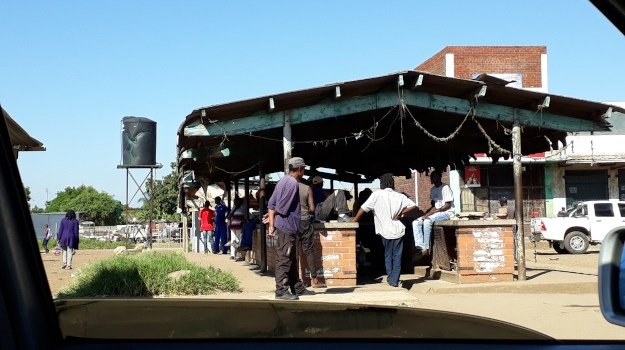
While all this was done in order to maximise the impact of social distancing, it has only managed to stop people from engaging in their various economic activities both in the suburbs and in the Harare CBD, where streets are now empty.

Law enforcement officers are not as visible as we expected, and on the few occasions they are seen, they are packed in a lorry, more than 50 in a 35-tonne truck, with no face masks. A bad example for practising social distancing – or physical distancing, as some prefer to call it.

Physical distancing has also proved to be a luxury for those in low-income, high-density suburbs.

On day two, people were still moving freely, only avoiding the main roads. At the local grocery shopping area in Glen View 1, 20km south west of Harare CBD, small groups of men were sitting enjoying their beer, sharing opaque beer even, oblivious of what this might do to their health if one of them were positive for the virus.

No power, a hunt for gas

On Saturday, after hearing that that a 21-day lockdown lay ahead, I set out to buy gas, as we were left with four days’ worth of supplies.

My neighbourhood and many others have not been connected to the power grid, 10 years after establishment.

The power utility, ZESA, does not have the required resources like cables and transformers, and – to a large extent – power itself.

Under normal circumstances, however, this would still only take me a couple of minutes, but on this day the queue for gas tanks was snaked for metres upon metres, and I had to spend six hours waiting for gas. Social distancing was a luxury.

Only one lady had a face mask. I had with me a small bottle of sanitiser, which I would apply every time we took turns to move the gas tanks, but as the day progressed, I abandoned its use. It was just not convenient at the time.

There’s toilet paper, but no one can afford it

Although we had stocked up on food the previous week, there were a few items we still needed. While government had assured the nation that grocery retailers would be open during the lockdown, one can never be 100% sure.

So on Sunday, we set out to get some food items, only to be greeted by an unpleasantly long queue. Again, physical distancing was a vain hope. While the outlet was letting in a few people at a time, outside customers were not leaving even a centimetre between them, as they pushed and shoved.

Inside the shop, it was evident supplies were running low. Some shelves were empty. We failed to get some basic necessities. Other products saw price hikes.

As for tissues and toilet paper? Unlike in other countries, it’s a product that is abundant in Zimbabwe. Hyperinflation has pushed the price toilet paper beyond the reach of many. Bread was now retailing at Z$40 up from Z$30 the previous day. But people still queued without keeping any distance.

It was the same today as I went out in preparation to write this article.

Desperation trumps distancing

People still queued to get some cooking gas. For two days, several neighbourhoods have not had power, forcing people to look for gas as an alternative, but it is also not readily available.

By 08:00hrs on Tuesday, the gas queue at one of the outlets was long and winding, with the place yet to open.

Another queue, as long as 50 metres, had also formed at grocery retail outlet that was yet to open.

Word was that subsidised maize meal had been delivered the previous night. With prices of basic products increasing by the day, as reflected by inflation for February 2020 at 540.16%, government is providing subsidised maize meal at Z$70.

However, supplies can’t meet the growing demand.

As a result, physical distancing was practically impossible. People shoved and jostled to keep their position in the queue. Some shouted at each other, risking drops of saliva.

Of the hundreds in the queue, not even one had a face mask.

As I drove back home, I passed through a community borehole, where a line was slowly forming. The neighbourhood has not had water for months and every day, residents come out to fetch water, and help each other pump it up. There is no sight of face masks or handy sanitisers, not in the ghetto.

The lockdown has only managed to stop economic activities, but social gatherings are inevitable.

Only hope and prayer can save Zimbabwe from Covid-19.

The post SPECIAL FEATURE | Inside Zimbabwe’s lockdown appeared first on Zimbabwe Situation.