MIXED FORTUNES FOR CHIVAYO

Controversial businessman Wicknell Chivayo has experienced a roller coaster life on his legal journey, as a senior official of the Zimbabwe Power Company (ZPC) partially exonerated him in his $5,6 million fraud trial on Friday.

This also comes as the …

Controversial businessman Wicknell Chivayo has experienced a roller coaster life on his legal journey, as a senior official of the Zimbabwe Power Company (ZPC) partially exonerated him in his $5,6 million fraud trial on Friday. This also comes as the Intratek Zimbabwe (Intratek) founder’s High Court bid to have the case dismissed collapsed on numerous occasions, while in another breath he has

Chivayo’s court relief, as ZPC boss exonerates him

Source: Chivayo’s court relief, as ZPC boss exonerates him | Daily News Controversial businessman Wicknell Chivayo has endured a roller coaster ride and mixed fortunes in his six-month bid for freedom, as his $5,6 million fraud case has taken interesting – if not intriguing – twists and turns since August 2018. While the self-styled tycoon has suffered […]

The post Chivayo’s court relief, as ZPC boss exonerates him appeared first on Zimbabwe Situation.

Source: Chivayo's court relief, as ZPC boss exonerates him | Daily News

Controversial businessman Wicknell Chivayo has endured a roller coaster ride and mixed fortunes in his six-month bid for freedom, as his $5,6 million fraud case has taken interesting – if not intriguing – twists and turns since August 2018.

While the self-styled tycoon has suffered numerous setbacks, including a January High Court order that he must face trial in the matter, the Zimbabwe Power Company (ZPC)’s financial director Eubert Chiwara has given him a boost by exonerating him and restating that Intratrek Zimbabwe (Intratrek) had been legitimately awarded the Gwanda solar project.

The parastatal boss’ testimony came under cross-examination by defence lawyer Lewis Uriri and on whether the local company was part of three compliant bidders – out of an initial list of six – that had been selected by the then State Procurement Board.

“It is alleged that the accused was paid without an advance payment guarantee, but… there was no need for advance payment guarantee because it was not an advance payment. ZPC was paying for work already done not which was to be done,” he said.

According to Uriri, Chivayo had done some on-site work in Matabeleland South, even though it was not complete because the ZPC had failed to obtain an environment impact assessment certificate from the Environmental Management Agency (EMA).

“ZPC had the obligation to secure EMA certificate within those 24 months. Accused could not do some of the work because at law you cannot do any project without being certified by EMA,” the feisty lawyer said.

Uriri said if there was under-performance, ZPC should seek remedy through the civil route or arbitration rather than pursuing criminal charges – a point that resonates with Justice Benjamin Chikowero’s August 2018 observation when he gave Chivayo a $2 000 bail.

The case, meanwhile, will be back in court on March 28 when the State is scheduled to call its second witness.

As the case has taken interesting twists and turns, Chivayo has also been dragged to court for numerous other cases related to the ZPC issue, including the alleged bribery of former ZPC chairman Stanley Kazhanje.

At some point, the state even contemplated combining the 36 year-old businessman’s trial with that of former Energy minister Samuel Undenge.

And Chivayo’s early victory last week also came as High Court judge Tawanda Chitapi had awarded him a $25 million civil damages award in December, and stated that the parties’ October 2015 contract was valid.

But Justice Joseph Musakwa said in late January that the burly businessman must face trial after upholding the Harare Magistrates’ Court’s decision to dismiss his exception application over the ZPC deal.

Crucially, Chivayo gave a sigh of relief when the learned judge threw out of the major charges against him which is money laundering charge. And in granting him bail in mid-August last year, Chikowero suggested that the case against the Intratrek founder was “weak and unsustainable to lead into lead a conviction”.

In his trial on Friday, Chivayo got a further boost and relief when Chiwara told the Harare Magistrates’ Court that the Intratrek tender was awarded after key recommendations by the ZPC evaluation committee and the then State Procurement Board.

When asked by Uriri, the parastatal purseman confirmed that the company and its board had done their own evaluations, and awarded the contract after input from supply chain managers.

The Temple Bar senior advocate argued that it was incorrect for the State to maintain that Chivayo had prejudiced the institution of nearly $6 million when work – valued at $3,6 million – had been done and an evaluation report by ZPC engineers had only red-flagged outstanding work of $1,8 million.

And in the Chitapi ruling, the court not only slammed the ZPC’s duplicity for instigating the youthful businessman’s arrest and seeking to frustrate the completion of the project, but that the contract could not be cancelled unilaterally.

Despite the fact that the Zesa subsidiary had listed former board member Tandiwe Mlobane as a complainant, the company made a serious about-turn in January by claiming that it had “nothing to do with the Intratrek owner’s arrest” – a development, which added another intriguing dimension to the saga.
The post Chivayo’s court relief, as ZPC boss exonerates him appeared first on Zimbabwe Situation.

Resolving Zim crisis benefits SA: Mutambara

Source: Resolving Zim crisis benefits SA: Mutambara – NewsDay Zimbabwe March 12, 2019 BY TATIRA ZWINOIRA Zimbabwe’s former Deputy Prime Minister Arthur Mutambara says South Africa should take a vested interest in tackling Zimbabwe’s economic crisis in order to prop up regional prosperity. This came as South African President Cyril Ramaphosa arrived in the country […]

The post Resolving Zim crisis benefits SA: Mutambara appeared first on Zimbabwe Situation.

Source: Resolving Zim crisis benefits SA: Mutambara – NewsDay Zimbabwe March 12, 2019

BY TATIRA ZWINOIRA

Zimbabwe’s former Deputy Prime Minister Arthur Mutambara says South Africa should take a vested interest in tackling Zimbabwe’s economic crisis in order to prop up regional prosperity.

This came as South African President Cyril Ramaphosa arrived in the country yesterday for the third session of the Zimbabwe-South Africa Bi-National Commission (BNC) that is envisaged to deepen bilateral relations and broaden mutually beneficial areas of co-operation between the two neighbouring countries.

“As Zimbabweans, we must be masters of our own destiny. We cannot continually outsource the resolution of our problems. Somehow, the buck stops with us as Zimbabweans and that is number one. Number two, South Africa must understand that under globalisation, South Africa is not competitive if Zimbabwe is not attractive,” Mutambara said in a recent interview on CNBC Africa.

“We are now moving away from national competitiveness to regional competiveness; from national attractiveness to regional attractiveness so the South Africans must take a vested interest approach to the resolution of the crisis in Zimbabwe because our survival (and) prosperity, bring about an environment where they can prosper better.”

According to South African media reports and prior to his arrival, at the top of Ramaphosa’s agenda was discussing financial assistance and the ongoing political and economic instability with his Zimbabwean counterpart President Emmerson Mnangagwa.

“Sadc must understand that we are now saying the region is a better unit of analysis that the nation State. The numbers themselves, 12 million people in Zimbabwe and 50 million in South Africa, this is chicken change. When you talk about Sadc, Comesa (Common Market for Eastern and Southern Africa) and the African continent, the African continent is 1,2 billion people, so numbers make a difference under globalisation,” Mutambara said.

“Continental integration and unity are the basis of our survival under globalisation, so we need regional sovereignty and continental sovereignty as opposed to national sovereignty.”

In December 2018, South Africa rejected Harare’s request for a $1,2 billion bailout.

Zimbabwean central bank officials revealed recently that South African banks were blocking Zimbabwean banks from importing United States dollars as a risk mitigating measure.

Analysts say this indicated that targeted sanctions were now affecting business and financial relations between the two countries, thus posing more problems for Mnangagwa and his administration’s efforts to keep the economy afloat.

South Africa is Zimbabwe’s largest trading partner, with annual trade between the two countries averaging between $4 billion and $5 billion per annum.

The post Resolving Zim crisis benefits SA: Mutambara appeared first on Zimbabwe Situation.

Editorial Comment: ED, Chamisa must stop massaging egos

Source: Editorial Comment: ED, Chamisa must stop massaging egos – NewsDay Zimbabwe March 12, 2019 Editorial Comment WHILE the call by MDC leader Nelson Chamisa for Zanu PF first secretary, President Emmerson Mnangagwa to urgently dialogue with him to rescue the country’s sinking economy might appear sincere on the surface, it is important for the […]

The post Editorial Comment: ED, Chamisa must stop massaging egos appeared first on Zimbabwe Situation.

Source: Editorial Comment: ED, Chamisa must stop massaging egos – NewsDay Zimbabwe March 12, 2019

Editorial Comment

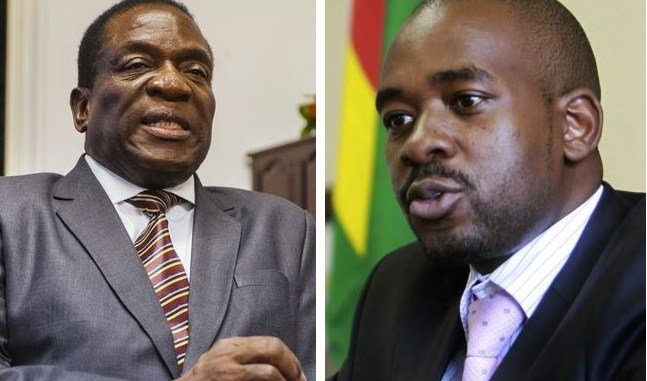
WHILE the call by MDC leader Nelson Chamisa for Zanu PF first secretary, President Emmerson Mnangagwa to urgently dialogue with him to rescue the country’s sinking economy might appear sincere on the surface, it is important for the two politicians to stop massaging their personal egos and genuinely engage each other for the benefit of the country.

The call appears very noble on the grounds of inclusivity, yet lack of trust and sincerity between the major players in Zimbabwe’s political realm has cost the country in a big way.

Although we cannot vouch for the veracity of the opposition political outfit’s power to shut its doors if Zanu PF continues to treat it as a minor player, what is clear is that both Mnangagwa and Chamisa have kept the country on hold for too long due to their antics.

It is important to understand that as the West, in particular the United States of America, visits economic sanctions against Zimbabwe, both Mnangagwa and Chamisa will never feel their effects, but the poor majority, who are their grassroots supporters, are feeling them big time.

It boggles the mind how long Zimbabweans should continue to suffer under the debilitating economic sanctions. It is our contention that Mnangagwa should show genuine Statesmanship and not this grandstanding he’s doing for the international world. It is time he becomes his own man and engages in serious dialogue with the youthful opposition leader.

The fact that he has appointed the Presidential Advisory Council from captains of industry or that because he rallied leaders of minor political outfits to a so-called dialogue does not, in any way, qualify him as a genuine Statesman. Otherwise, the PAC will still be hamstrung by Zanu PF politics, the same politics derailing his reform agenda.

Zimbabweans who bear the brunt of the economic malaise can see through Mnangagwa’s machinations — that he is desperate to get international recognition, yet nothing really tangible is happening on the ground by way of economic and political reforms.

We believe that the President has more to lose than Chamisa given he’s supposed to be a leader of all Zimbabweans. Grandstanding won’t get him anywhere.
Citizens demand action.

What has happened to Mnangagwa’s proposal that Zimbabwe officially recognises the position of the leader of the main opposition? Who is stalling this process if the President wants to push forward with the economic and political reforms? It is time Mnangagwa stops accusing the opposition of stalling economic progress when he appears clueless in the face of Zimbabweans.

In fact, if the governing Zanu PF party does not move forward with the needed reforms, Mnangagwa would likely go down in history as the country’s worst leader.

With all the bickering dominating the political landscape, it is clear that citizens are not happy with their political leaders. Citizens are yearning for leaders with their interests at heart, not this self-serving lot eager to amass wealth and massage their egos while seated on top of emaciated bodies worn out by poverty.

If dialogue is what will get Zimbabwe back on track, why is it taking our political leaders long to sit around the table and iron out their differences once-and-for-all?

We call on Chamisa and Mnangagwa to put their differences away and move the country forward. Each of them commands a huge following in the country, hence there’s no need for any of them to feel superior over the other.

This hubris must just stop.

The post Editorial Comment: ED, Chamisa must stop massaging egos appeared first on Zimbabwe Situation.

Drama as Zimbabweans blast ZBC after announcing introduction of News App

ZBC News announced on Monday that it has introduced an app which allows its viewers to watch news bulletins and programmes from anywhere across the world. Below is how people reacted to the announcement on Twitter: Shakespeares’ Son Replying to @ZBCNew…

ZBC News announced on Monday that it has introduced an app which allows its viewers to watch news bulletins and programmes from anywhere across the world. Below is how people reacted to the announcement on Twitter: Shakespeares’ Son Replying to @ZBCNewsonline The comments here I laughed my lungs out! Hope whoever manages this ZBC page […]