A Reward Is Not a Strategy: What the Guruve Killings Now Demand From the State:

Source: A Reward Is Not a Strategy: What the Guruve Killings Now Demand From the State: For the first time in months, the State has visibly reacted to the terror that has gripped Guruve since October. The Zimbabwe Republic Police have announced an intensified manhunt. Specialised units have been deployed. Soldiers have been seen patrolling […]

The post A Reward Is Not a Strategy: What the Guruve Killings Now Demand From the State: appeared first on Zimbabwe Situation.

Source: A Reward Is Not a Strategy: What the Guruve Killings Now Demand From the State:

For the first time in months, the State has visibly reacted to the terror that has gripped Guruve since October.

The Zimbabwe Republic Police have announced an intensified manhunt. Specialised units have been deployed. Soldiers have been seen patrolling alongside police formations. Most recently, the Police Commissioner issued a public appeal offering a “substantial” financial reward to anyone who provides information leading to the arrest of the named suspect.

This response deserves acknowledgment. It signals movement. It signals recognition. It signals that the killings in Guruve are no longer being treated as isolated incidents.

But acknowledgment must not be mistaken for conclusion.

Because the question Zimbabweans must now ask is no longer whether the State is responding — it is how it is responding, what logic guides that response, and whether it matches the scale and nature of the crisis unfolding in one rural district of our country.

Sixteen people — possibly more, according to unconfirmed local reports — have been brutally murdered within roughly eighty days. Women and children have been attacked in their sleep. Entire families have been wiped out. Villages have been paralysed by fear. Communities have reorganised their lives around night vigils, group sleeping arrangements, and constant dread.

This is not ordinary crime. It is organised terror.

When a Reward Becomes the Centrepiece:<

The announcement of a financial reward is, on the surface, a reasonable policing tool. Rewards can assist investigations. They can unlock information. They can encourage reluctant witnesses to speak.

But when a reward becomes the headline response to serial killings, it quietly reveals something deeper about how the crisis is being framed.

A reward is a reactive instrument. It helps solve a crime after the fact. It does not stop killings in real time. It does not reassure terrified families that the night will pass safely. It does not signal that the State has seized control of a situation that has already escalated far beyond normal criminality.

In moments of sustained violence, a reward should complement strategy — not substitute for it.

More troubling still is the vagueness of the offer. The amount is undisclosed. The conditions are unclear. The framing subtly shifts urgency from the State to the citizen: bring information, and you will be rewarded.

But people living under fear do not need incentives. They need protection. They need certainty. They need to know that the State is not merely hunting a suspect, but containing a threat.

The Problem of Trust and the Question of Identity:

Compounding anxiety is the controversy surrounding the suspect’s identity. The photograph circulated by police has reportedly been rejected by relatives and villagers as incorrect. Whether this dispute is valid or not is not the central issue.

The issue is confidence.

In rural communities already traumatised by violence, precision matters. Accuracy matters. Trust matters. A single misstep in identification can fracture cooperation, fuel rumours, and deepen fear. It can also expose innocent people to suspicion or retaliation.

In crises of this nature, community confidence is not a public relations concern — it is an operational necessity.

The State cannot afford uncertainty where terror already reigns.

Uniforms Without Explanation:

There is now a visible security presence in Guruve. Police Support Unit. Specialised investigators. Soldiers.

Visibility matters. It reassures. But visibility without explanation also unsettles. What is the mission? Who is in command? What zones are secured? What benchmarks define progress?

Silence invites speculation. In frightened communities, speculation breeds panic.

Security deployments must be accompanied by clear, consistent communication — not just press statements in Harare, but daily, local briefings that tell people what is being done, why it is being done, and what comes next.

Uniforms deter only when purpose is understood.

Leadership and the Weight of Presence:

At the national level, something else is missing. Voice. There has been no direct address from the Head of State on the Guruve killings. The President is reportedly on annual leave. The Acting President has appeared at routine public and religious events, projecting normalcy in a moment that is anything but normal for families in Mashonaland Central.

This observation is not an accusation. It is an appeal. In any country that claims peace as a national identity, the sustained killing of civilians in one district demands symbolic leadership as much as operational response.

A short address. A visit. A declaration that this is a national concern.

These are not theatrics. They are stabilising signals. They tell citizens that their lives are visible, that their fear is acknowledged, that the State understands the gravity of what is happening.

Leadership silence, even when procedural, lands as distance.

What Seriousness Would Look Like:

If Guruve is to be treated with the seriousness its tragedy demands, several measures should now be non-negotiable:

A formal declaration of Guruve as a special security zone until the threat is neutralised.

• Establishment of a permanent on-site command centre coordinating police, intelligence, and community leadership.

Daily public briefings — even if there is little progress — to maintain trust and transparency.

Visible victim support mechanisms for affected families, beyond crime-scene responses.

These are not extraordinary demands. They are standard responses to sustained, patterned violence.

Why This Matters Beyond Guruve:

How a State responds to violence in a rural district is a measure of how it values rural lives.

If killings of this magnitude can stretch over months without triggering national urgency, then peace becomes a slogan rather than a lived reality. Safety becomes selective. Citizenship becomes uneven.

Zimbabwe cannot afford that.

A nation is not judged by how loudly it celebrates unity or peace days. It is judged by how urgently it confronts violence when it appears — especially when it appears far from the cameras, far from capital cities, far from political spectacle.

The people of Guruve are not asking for miracles. They are asking for seriousness.

A reward may help catch a suspect. But only strategy, leadership, and urgency will stop the terror.

And that is what this moment now demands.

The post A Reward Is Not a Strategy: What the Guruve Killings Now Demand From the State: appeared first on Zimbabwe Situation.
A Reward Is Not a Strategy: What the Guruve Killings Now Demand From the State:

Source: A Reward Is Not a Strategy: What the Guruve Killings Now Demand From the State: For the first time in months, the State has visibly reacted to the terror that has gripped Guruve since October. The Zimbabwe Republic Police have announced an intensified manhunt. Specialised units have been deployed. Soldiers have been seen patrolling […]

The post A Reward Is Not a Strategy: What the Guruve Killings Now Demand From the State: appeared first on Zimbabwe Situation.

Source: A Reward Is Not a Strategy: What the Guruve Killings Now Demand From the State:

For the first time in months, the State has visibly reacted to the terror that has gripped Guruve since October.

The Zimbabwe Republic Police have announced an intensified manhunt. Specialised units have been deployed. Soldiers have been seen patrolling alongside police formations. Most recently, the Police Commissioner issued a public appeal offering a “substantial” financial reward to anyone who provides information leading to the arrest of the named suspect.

This response deserves acknowledgment. It signals movement. It signals recognition. It signals that the killings in Guruve are no longer being treated as isolated incidents.

But acknowledgment must not be mistaken for conclusion.

Because the question Zimbabweans must now ask is no longer whether the State is responding — it is how it is responding, what logic guides that response, and whether it matches the scale and nature of the crisis unfolding in one rural district of our country.

Sixteen people — possibly more, according to unconfirmed local reports — have been brutally murdered within roughly eighty days. Women and children have been attacked in their sleep. Entire families have been wiped out. Villages have been paralysed by fear. Communities have reorganised their lives around night vigils, group sleeping arrangements, and constant dread.

This is not ordinary crime. It is organised terror.

When a Reward Becomes the Centrepiece:<

The announcement of a financial reward is, on the surface, a reasonable policing tool. Rewards can assist investigations. They can unlock information. They can encourage reluctant witnesses to speak.

But when a reward becomes the headline response to serial killings, it quietly reveals something deeper about how the crisis is being framed.

A reward is a reactive instrument. It helps solve a crime after the fact. It does not stop killings in real time. It does not reassure terrified families that the night will pass safely. It does not signal that the State has seized control of a situation that has already escalated far beyond normal criminality.

In moments of sustained violence, a reward should complement strategy — not substitute for it.

More troubling still is the vagueness of the offer. The amount is undisclosed. The conditions are unclear. The framing subtly shifts urgency from the State to the citizen: bring information, and you will be rewarded.

But people living under fear do not need incentives. They need protection. They need certainty. They need to know that the State is not merely hunting a suspect, but containing a threat.

The Problem of Trust and the Question of Identity:

Compounding anxiety is the controversy surrounding the suspect’s identity. The photograph circulated by police has reportedly been rejected by relatives and villagers as incorrect. Whether this dispute is valid or not is not the central issue.

The issue is confidence.

In rural communities already traumatised by violence, precision matters. Accuracy matters. Trust matters. A single misstep in identification can fracture cooperation, fuel rumours, and deepen fear. It can also expose innocent people to suspicion or retaliation.

In crises of this nature, community confidence is not a public relations concern — it is an operational necessity.

The State cannot afford uncertainty where terror already reigns.

Uniforms Without Explanation:

There is now a visible security presence in Guruve. Police Support Unit. Specialised investigators. Soldiers.

Visibility matters. It reassures. But visibility without explanation also unsettles. What is the mission? Who is in command? What zones are secured? What benchmarks define progress?

Silence invites speculation. In frightened communities, speculation breeds panic.

Security deployments must be accompanied by clear, consistent communication — not just press statements in Harare, but daily, local briefings that tell people what is being done, why it is being done, and what comes next.

Uniforms deter only when purpose is understood.

Leadership and the Weight of Presence:

At the national level, something else is missing. Voice. There has been no direct address from the Head of State on the Guruve killings. The President is reportedly on annual leave. The Acting President has appeared at routine public and religious events, projecting normalcy in a moment that is anything but normal for families in Mashonaland Central.

This observation is not an accusation. It is an appeal. In any country that claims peace as a national identity, the sustained killing of civilians in one district demands symbolic leadership as much as operational response.

A short address. A visit. A declaration that this is a national concern.

These are not theatrics. They are stabilising signals. They tell citizens that their lives are visible, that their fear is acknowledged, that the State understands the gravity of what is happening.

Leadership silence, even when procedural, lands as distance.

What Seriousness Would Look Like:

If Guruve is to be treated with the seriousness its tragedy demands, several measures should now be non-negotiable:

A formal declaration of Guruve as a special security zone until the threat is neutralised.

• Establishment of a permanent on-site command centre coordinating police, intelligence, and community leadership.

Daily public briefings — even if there is little progress — to maintain trust and transparency.

Visible victim support mechanisms for affected families, beyond crime-scene responses.

These are not extraordinary demands. They are standard responses to sustained, patterned violence.

Why This Matters Beyond Guruve:

How a State responds to violence in a rural district is a measure of how it values rural lives.

If killings of this magnitude can stretch over months without triggering national urgency, then peace becomes a slogan rather than a lived reality. Safety becomes selective. Citizenship becomes uneven.

Zimbabwe cannot afford that.

A nation is not judged by how loudly it celebrates unity or peace days. It is judged by how urgently it confronts violence when it appears — especially when it appears far from the cameras, far from capital cities, far from political spectacle.

The people of Guruve are not asking for miracles. They are asking for seriousness.

A reward may help catch a suspect. But only strategy, leadership, and urgency will stop the terror.

And that is what this moment now demands.

The post A Reward Is Not a Strategy: What the Guruve Killings Now Demand From the State: appeared first on Zimbabwe Situation.

Foreign Office cautioned against UK military action to overthrow Robert Mugabe 

Archives reveal options considered by Tony Blair’s government for dealing with Zimbabwean dictator in 2004 Source: Foreign Office cautioned against UK military action to overthrow Robert Mugabe | Robert Mugabe | The Guardian Tony Blair and Robert Mugabe in Commonwealth talks in 1997. The Foreign Office dismissed military action as not a ‘serious option’ for […]

The post Foreign Office cautioned against UK military action to overthrow Robert Mugabe  appeared first on Zimbabwe Situation.

Archives reveal options considered by Tony Blair’s government for dealing with Zimbabwean dictator in 2004

Source: Foreign Office cautioned against UK military action to overthrow Robert Mugabe | Robert Mugabe | The Guardian

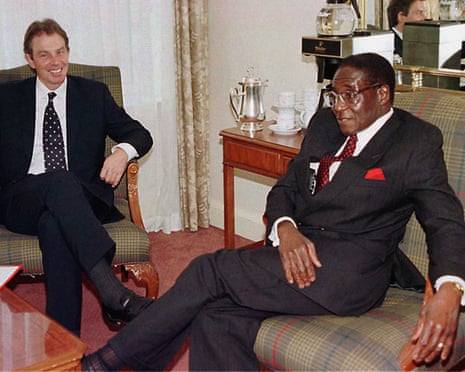
Tony Blair and Robert Mugabe in Commonwealth talks in 1997. The Foreign Office dismissed military action as not a ‘serious option’ for dismantling Mugabe’s regime. Photograph: PA

The Foreign Office cautioned against UK military intervention to overthrow the former Zimbabwean president Robert Mugabe in 2004, advising it was not a “serious option”, recently released documents show.

Policy papers show Tony Blair’s government weighed up options on how best to handle the “depressingly healthy” 80-year-old dictator, who refused to step down while the country descended into violence and economic chaos.

Faced with Mugabe’s Zanu-PF party winning a 2005 election, and a year after the UK joined a US coalition to overthrow the Iraqi leader Saddam Hussein, No 10 asked the Foreign Office in July 2004 to produce options.

Officials agreed the UK’s policy of isolating Mugabe and building an international consensus for change was not working, and had not managed to secure support from key Africans, notably the then South African president Thabo Mbeki, documents released to the National Archives at Kew, west London, show.

Options outlined included: “seek to remove Mugabe by force”; “go for tougher UK measures” such as freezing assets and closing the UK embassy; or “re-engage”, the option advocated by the then outgoing ambassador to Zimbabwe, Brian Donnelly, according to the files.

The FCO paper dismissed military action as not a “serious option,” and advised: “We know from Afghanistan, Iraq and Yugoslavia that changing a government and/or its bad policies is almost impossible from the outside. If we really wanted to change the situation on the ground in Zimbabwe we have to do to Mugabe what we have just done to Saddam.”

It adds: “The only candidate for leading such a military operation is the UK. No one else (even the US) would be prepared to do so”.

It warns that military intervention would result in heavy casualties and have “considerable implications” for British people in Zimbabwe.

“Short of a major humanitarian and political catastrophe – resulting in massive violence, large-scale refugee flows, and regional instability – we judge that no African state would agree to any attempts to remove Mugabe forcibly.”

It continues: “Nor do we judge that any other European, Commonwealth or western partner (including the US) would authorise or participate in military intervention. And there would be no legal grounds for doing so, without an authorising Security Council Resolution, which we would not get.”

Blair’s foreign policy adviser Laurie Lee warned him Zimbabwe “will be a real spoiler” to his plan to use the UK’s presidency of the G8 to make 2005 “the year of Africa” at a summit at Gleneagles. Lee concluded that as military action had been ruled out, “we probably have to accept that we must play the longer game” and re-engage with Mugabe.

Blair appeared to agree, writing: “We should work out a way of exposing the lies and malpractice of Mugabe and Zanu-PF up to this election and then afterwards, we could try-to re-engage on the basis of a clear understanding of what that means. So we could try a variant of what Brian D [Donnelly] says. I can see a way of making it work but we need to have the FCO work out a complete strategy”.

Donnelly, in his valedictory telegram, had advocated critical re-engagement with Mugabe, though understood Blair “might shudder at the thought given all that Mugabe has said and done”.

Mugabe was finally deposed in a 2017 coup, aged 93. Mbeki claimed in 2013 that in the early 2000s Blair had tried to pressurise him into joining a military coalition to overthrow Mugabe, a claim strongly denied by Blair.

The post Foreign Office cautioned against UK military action to overthrow Robert Mugabe  appeared first on Zimbabwe Situation.

Foreign Office cautioned against UK military action to overthrow Robert Mugabe 

Archives reveal options considered by Tony Blair’s government for dealing with Zimbabwean dictator in 2004 Source: Foreign Office cautioned against UK military action to overthrow Robert Mugabe | Robert Mugabe | The Guardian Tony Blair and Robert Mugabe in Commonwealth talks in 1997. The Foreign Office dismissed military action as not a ‘serious option’ for […]

The post Foreign Office cautioned against UK military action to overthrow Robert Mugabe  appeared first on Zimbabwe Situation.

Archives reveal options considered by Tony Blair’s government for dealing with Zimbabwean dictator in 2004

Source: Foreign Office cautioned against UK military action to overthrow Robert Mugabe | Robert Mugabe | The Guardian

Tony Blair and Robert Mugabe in Commonwealth talks in 1997. The Foreign Office dismissed military action as not a ‘serious option’ for dismantling Mugabe’s regime. Photograph: PA

The Foreign Office cautioned against UK military intervention to overthrow the former Zimbabwean president Robert Mugabe in 2004, advising it was not a “serious option”, recently released documents show.

Policy papers show Tony Blair’s government weighed up options on how best to handle the “depressingly healthy” 80-year-old dictator, who refused to step down while the country descended into violence and economic chaos.

Faced with Mugabe’s Zanu-PF party winning a 2005 election, and a year after the UK joined a US coalition to overthrow the Iraqi leader Saddam Hussein, No 10 asked the Foreign Office in July 2004 to produce options.

Officials agreed the UK’s policy of isolating Mugabe and building an international consensus for change was not working, and had not managed to secure support from key Africans, notably the then South African president Thabo Mbeki, documents released to the National Archives at Kew, west London, show.

Options outlined included: “seek to remove Mugabe by force”; “go for tougher UK measures” such as freezing assets and closing the UK embassy; or “re-engage”, the option advocated by the then outgoing ambassador to Zimbabwe, Brian Donnelly, according to the files.

The FCO paper dismissed military action as not a “serious option,” and advised: “We know from Afghanistan, Iraq and Yugoslavia that changing a government and/or its bad policies is almost impossible from the outside. If we really wanted to change the situation on the ground in Zimbabwe we have to do to Mugabe what we have just done to Saddam.”

It adds: “The only candidate for leading such a military operation is the UK. No one else (even the US) would be prepared to do so”.

It warns that military intervention would result in heavy casualties and have “considerable implications” for British people in Zimbabwe.

“Short of a major humanitarian and political catastrophe – resulting in massive violence, large-scale refugee flows, and regional instability – we judge that no African state would agree to any attempts to remove Mugabe forcibly.”

It continues: “Nor do we judge that any other European, Commonwealth or western partner (including the US) would authorise or participate in military intervention. And there would be no legal grounds for doing so, without an authorising Security Council Resolution, which we would not get.”

Blair’s foreign policy adviser Laurie Lee warned him Zimbabwe “will be a real spoiler” to his plan to use the UK’s presidency of the G8 to make 2005 “the year of Africa” at a summit at Gleneagles. Lee concluded that as military action had been ruled out, “we probably have to accept that we must play the longer game” and re-engage with Mugabe.

Blair appeared to agree, writing: “We should work out a way of exposing the lies and malpractice of Mugabe and Zanu-PF up to this election and then afterwards, we could try-to re-engage on the basis of a clear understanding of what that means. So we could try a variant of what Brian D [Donnelly] says. I can see a way of making it work but we need to have the FCO work out a complete strategy”.

Donnelly, in his valedictory telegram, had advocated critical re-engagement with Mugabe, though understood Blair “might shudder at the thought given all that Mugabe has said and done”.

Mugabe was finally deposed in a 2017 coup, aged 93. Mbeki claimed in 2013 that in the early 2000s Blair had tried to pressurise him into joining a military coalition to overthrow Mugabe, a claim strongly denied by Blair.

The post Foreign Office cautioned against UK military action to overthrow Robert Mugabe  appeared first on Zimbabwe Situation.