
India and Zimbabwe agree to enhance bilateral defence ties by expanding existing cooperation

Source: India and Zimbabwe agree to enhance bilateral defence ties by expanding existing cooperation  | Akashvani News India and Zimbabwe today reaffirmed their commitment to deepen bilateral defence cooperation during the inaugural meeting of the India-Zimbabwe Joint Defence Committee held in New Delhi. Joint Secretary (International Cooperation) in the Ministry of Defence, Amitabh Prasad and […]

The post India and Zimbabwe agree to enhance bilateral defence ties by expanding existing cooperation appeared first on Zimbabwe Situation.

Source: India and Zimbabwe agree to enhance bilateral defence ties by expanding existing cooperation  | Akashvani News

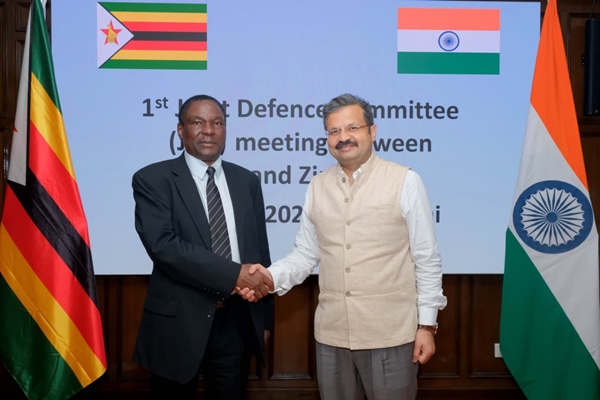
India and Zimbabwe today reaffirmed their commitment to deepen bilateral defence cooperation during the inaugural meeting of the India-Zimbabwe Joint Defence Committee held in New Delhi. Joint Secretary (International Cooperation) in the Ministry of Defence, Amitabh Prasad and Permanent Secretary of Zimbabwe, Aaron Daniel Tonde Nhepera, co-chaired the meeting. Both sides agreed to enhance bilateral defence ties by expanding existing cooperation in areas such as training, support and maintenance of common air assets. They also discussed ways to collaborate in new areas including joint manufacturing, counter-terrorism, border management and peacekeeping. Defence Ministry said that the meeting further reinforced ties by operationalising the objectives laid down in the Memorandum of Understanding on Defence Cooperation signed by the Defence Ministers of both countries on the sidelines of Aero India 2025.

The post India and Zimbabwe agree to enhance bilateral defence ties by expanding existing cooperation appeared first on Zimbabwe Situation.

Even a scoring Mbappé leaves the pitch after 90 minutes: Mnangagwa must exit in 2028

Source: Even a scoring Mbappé leaves the pitch after 90 minutes: Mnangagwa must exit in 2028 Trying too hard to justify the absurd only makes the speaker look ridiculous. Tendai Ruben Mbofana When a ruling party resorts to sports metaphors to justify altering a nation’s foundational law, it inadvertently hands its critics the perfect tools […]

The post Even a scoring Mbappé leaves the pitch after 90 minutes: Mnangagwa must exit in 2028 appeared first on Zimbabwe Situation.

Source: Even a scoring Mbappé leaves the pitch after 90 minutes: Mnangagwa must exit in 2028

Trying too hard to justify the absurd only makes the speaker look ridiculous.

Tendai Ruben Mbofana

When a ruling party resorts to sports metaphors to justify altering a nation’s foundational law, it inadvertently hands its critics the perfect tools for its own intellectual dismantling.

If you value my social justice advocacy and writing, please consider a financial contribution to keep it going. Contact me on WhatsApp: +263 715 667 700 or Email: mbofana.tendairuben73@gmail.com

The recent parliamentary debates on Constitutional Amendment (No. 3) Bill, or CAB3, exposed a profoundly flawed line of reasoning championed by ZANU-PF legislators.

MP Perseverance Zhou’s explicit comparison of President Emmerson Mnangagwa to French football star Kylian Mbappé—demanding to know why we should stop a striker who is actively scoring developmental goals—is more than just colorful political rhetoric.

It is a dangerous misreading of both the beautiful game and the mechanics of constitutional democracy.

By examining this very metaphor under the uncompromising light of logic, the entire argument for a 2030 term extension completely unravels.

The core fallacy of the scoring argument lies in a fundamental misunderstanding of timekeeping.

In football, a match lasts exactly ninety minutes plus standard stoppage time.

Even if Mbappé is on a magnificent hat-trick, completely dominating the pitch, and dazzling the crowd, the final whistle blows the exact second the clock runs out.

FIFA does not, and will never, change the rules of football to lengthen a match just because a single star player is performing well.

To do so would subvert the entire integrity of the sport.

In the political reality of Zimbabwe, the current constitutional limit is that final whistle.

When 2028 arrives, the match is over for this presidency.

A high-performing leader does not grant a nation the license to arbitrarily add extra time to the clock.

Furthermore, the ruling party’s frantic defense that Mnangagwa is already in the eighteen-yard box and possessing unstoppable momentum misinterprets how rules govern a game.

In football, if a striker enters the penalty area, dribbles past the last defender, and is actively drawing back their leg to shoot, the referee will still blow the final whistle if the ninety minutes have elapsed.

The ball does not get a free pass to cross the goal line simply because it was close.

Momentum yields to the clock; it never overrides it.

Therefore, arguing that CAB3 should pass because the president is in the middle of executing developmental projects is legally and logically bankrupt.

The rules dictate the timeline of the game, not the position of the player on the pitch.

This brings us to the crucial distinction between being substituted and the match simply ending.

ZANU-PF figures frame the constitutional term limit as an unfair premature substitution—taking a star player off the field while they are still full of energy.

But the constitution is not a manager holding up a substitution board in the seventy-fifth minute.

The constitution is the stadium clock.

In 2028, Mnangagwa is not being forced onto the bench while the game continues without him; the match itself has reached its lawful conclusion.

Beyond the immediate mechanics of the game, we must confront the broader danger of altering rules for the sake of an individual.

Constitutions, like the laws of football, are designed to outlive and outweigh any single person, no matter how talented or powerful they are perceived to be.

If FIFA began rewriting rulebooks mid-tournament to accommodate the peak performance of a single generation’s favorite athlete, global football would instantly collapse into absolute disorder.

We would find ourselves in the ludicrous position where FIFA officials at the 2026 World Cup arbitrarily grant France an extra thirty minutes of play simply because Kylian Mbappé is having a brilliant afternoon on the pitch.

Predictability would vanish, fairness would be obliterated, and the game would cease to be a sport, transforming instead into a scripted exhibition.

When a nation tampers with its supreme law to cater to the ambitions or performance of one man, it invites that exact brand of institutional disorder into its governance.

A functional democracy thrives on the certainty of its systems, not the indispensability of its leaders.

The “indispensable leader” narrative is an ancient trap that historically births autocracy.

By arguing that the country cannot transition because one specific individual is “scoring,” the ruling party quietly makes a damning admission: they are admitting they have failed to build institutional continuity or cultivate a deep bench of leadership within their own ranks.

A truly successful team does not collapse when a striker’s time is up; it relies on a robust system that trains the next generation to take the field.

Worryingly, altering constitutional rules mid-stream shatters the social contract and destroys future political stability.

It sets a catastrophic precedent that transforms the supreme law of the land into a malleable document, easily bent by whoever holds temporary legislative power.

If the rules can be rewritten to extend a term today under the guise of development, they can be rewritten tomorrow to erase accountability entirely.

This creates an environment of profound unpredictability that deters long-term investment, fractures national unity, and undermines the very developmental goals the ruling party claims to protect.

Ultimately, no single player is bigger than the game, and no single politician is bigger than the republic.

The rules must remain blind to performance, personality, and political power.

When the final whistle blows in 2028, the match ends.

To demand an extension because a leader is in the eighteen-yard box is to demand a breakdown of legal order.

For the sake of the nation’s democratic integrity, the rules must be respected, the clock must be obeyed, and the final whistle must be honored.
The post Even a scoring Mbappé leaves the pitch after 90 minutes: Mnangagwa must exit in 2028 appeared first on Zimbabwe Situation.

Zimbabwe mining sector generates US$2bn in first half

Zimbabwe’s mining sector generated approximately US$2 billion in revenue during the first half of the year, reinforcing its position as the country’s leading source of foreign currency earnings and a key pillar of economic growth. Mines and Mining Development Minister Polite Kambamura said the strong performance had laid the foundation for even greater returns in […]

The post Zimbabwe mining sector generates US$2bn in first half appeared first on The Zimbabwe Mail.

Zimbabwe’s mining sector generated approximately US$2 billion in revenue during the first half of the year, reinforcing its position as the country’s leading source of foreign currency earnings and a key pillar of economic growth.

Mines and Mining Development Minister Polite Kambamura said the strong performance had laid the foundation for even greater returns in the second half of the year, with export receipts projected to reach between US$6.5 billion and US$7 billion by year-end.

“The first half of the year was about US$2 billion in revenue. Going forward, we are looking at around US$6,5 billion to US$7 billion in export receipts, anchored by minerals such as gold,” Kambamura said during a media briefing in Harare on Thursday.

The minister attributed the optimistic outlook to favourable global commodity prices, particularly for gold, as well as improving prospects for platinum group metals (PGMs), which remain among Zimbabwe’s most valuable mineral exports.

Gold has emerged as the primary driver of growth within the mining industry, benefiting from strong international prices that have boosted producer earnings and enhanced the country’s export potential.

Kambamura said Zimbabwe remains on track to achieve its annual gold production target of 50 tonnes and could potentially exceed that figure as authorities intensify efforts to ensure that all production is channelled through formal marketing systems.

“We have introduced policies to make sure that every ounce of gold is delivered,” he said.

“As a ministry, we will be looking at those deliveries with an eagle eye to ensure that every miner who is digging for gold contributes meaningful returns to government.”

The government’s emphasis on formal gold deliveries comes amid persistent concerns over smuggling and under-reporting, which have historically cost the country significant export earnings and tax revenues.

Authorities have repeatedly identified illicit gold trading as one of the major obstacles to maximising value from Zimbabwe’s mineral wealth, prompting a range of measures aimed at improving compliance, strengthening oversight and increasing accountability within the sector.

In addition to gold, Kambamura expressed confidence that improving prices for platinum group metals would further support export growth during the remainder of the year.

“The world market price for gold continues to firm up, while PGM prices are also strengthening,” he said.

Mining remains at the centre of Zimbabwe’s economic development strategy, accounting for the majority of export earnings and providing critical foreign currency needed to support industrial production, imports and broader economic activity.

The projected increase in export receipts is expected to strengthen foreign currency inflows and boost government revenues at a time when authorities are increasingly relying on the extractive sector to drive economic expansion and investment.

With global commodity markets remaining supportive and production trends continuing to improve, the mining sector appears well positioned to build on its first-half performance and further consolidate its role as the backbone of Zimbabwe’s export economy.

Source – The Independent

The post Zimbabwe mining sector generates US$2bn in first half appeared first on The Zimbabwe Mail.

World Cup 2026 raises unprecedented security challenge amid heightened global tensions. Is the US ready?

NEW YORK — The FIFA World Cup 2026, a sprawling 48-team tournament featuring 104 matches across 16 host cities in the United States, Mexico and Canada, is shaping up to be one of the most logistically complex and security-intensive sporting events ever staged, according to the Associated Press. Set against a volatile international backdrop marked by […]

The post World Cup 2026 raises unprecedented security challenge amid heightened global tensions. Is the US ready? appeared first on The Zimbabwe Mail.

NEW YORK — The FIFA World Cup 2026, a sprawling 48-team tournament featuring 104 matches across 16 host cities in the United States, Mexico and Canada, is shaping up to be one of the most logistically complex and security-intensive sporting events ever staged, according to the Associated Press.

Set against a volatile international backdrop marked by geopolitical tensions, domestic political polarisation in the United States, and accelerating concerns over artificial intelligence-enabled disruption, authorities are preparing for a security operation of exceptional scale and sophistication.

The tournament — officially part of the expanded FIFA World Cup 2026 — will unfold across a vast continental footprint, stretching from major US metropolitan hubs such as New York, Los Angeles, Dallas and Miami, to host cities in Mexico and Canada. The sheer geographic dispersion alone presents a unique coordination challenge for security agencies.

A security environment defined by multiple threat layers

Officials and security analysts describe the risk environment surrounding the tournament as “multi-dimensional”, combining traditional physical security concerns with emerging digital and technological threats.

At the forefront are longstanding risks associated with large-scale international sporting events: terrorism, crowd control, and the protection of high-profile venues hosting tens of thousands of spectators per match. However, these are now compounded by newer and less predictable threats.

The ongoing geopolitical tensions involving the United States, Israel and Iran have heightened concerns about potential retaliatory or symbolic attacks targeting Western interests abroad and at home. While no specific credible threats have been publicly confirmed in relation to the tournament, intelligence agencies are expected to maintain heightened vigilance throughout the competition period.

Domestic volatility adds complexity

Within the United States, rising political polarisation and incidents of political violence linked to fringe actors have added another layer of concern for law enforcement agencies. Large-scale public events featuring global audiences and political visibility are often assessed as potential soft targets for disruption or high-impact incidents.

Security planning is therefore expected to extend beyond stadium perimeters, encompassing fan zones, transport hubs, hotels, and public viewing areas across host cities.

Cybersecurity and AI-driven risks

Perhaps the most rapidly evolving dimension of the security challenge is digital.

Experts warn that the tournament will be a prime target for cyberattacks ranging from ransomware campaigns against critical infrastructure to attempts to disrupt ticketing systems, broadcast feeds, and transportation networks.

In addition, security planners are increasingly focused on the potential misuse of artificial intelligence. Deepfake technology, automated disinformation campaigns, and AI-assisted phishing operations are all considered credible tools for sowing confusion, amplifying panic, or undermining public trust during the event.

Officials are expected to deploy advanced threat detection systems and coordinate closely with technology companies to monitor and counteract synthetic media and coordinated online manipulation campaigns.

Scale of coordination unprecedented

The expanded format of the tournament significantly increases operational complexity. With 48 national teams, hundreds of thousands of travelling supporters, and matches spread across three countries, coordination between federal, state, and local security agencies will be critical.

In the United States alone, agencies including federal homeland security structures, intelligence services, and local law enforcement departments will be required to operate in tightly synchronised command frameworks. Cross-border coordination with Mexico and Canada further adds to the logistical challenge.

Transport infrastructure — including airports, rail systems, highways and urban transit networks — will also fall under heightened surveillance and contingency planning.

Lessons from past global events

Security planners are drawing lessons from previous mega-events such as the Olympics and earlier World Cups, where layered security perimeters, intelligence-sharing mechanisms, and public-private partnerships proved essential in preventing major incidents.

However, analysts caution that the scale and geopolitical context of the 2026 tournament make it distinctly more complex than previous editions. The combination of a vast geographic footprint and an intensified global threat environment has no direct modern precedent in international sport.

A defining test for US-led coordination

For the United States and its partners, the tournament will represent not only a sporting showcase but also a test of advanced security coordination in an era defined by hybrid threats — physical, digital and psychological.

As preparations intensify, officials are emphasising resilience, rapid response capability, and real-time intelligence integration as key pillars of the security strategy.

While the tournament is expected to deliver one of the largest global sporting spectacles in history, it will also serve as a critical examination of whether contemporary security systems can effectively manage risk at unprecedented scale in an increasingly unpredictable world.

The post World Cup 2026 raises unprecedented security challenge amid heightened global tensions. Is the US ready? appeared first on The Zimbabwe Mail.

Centragrid Solar Plant delivers 25MW boost to Zimbabwe’s renewable energy supply

HARARE — The Centragrid Solar Power Plant, located in Nyabira in Mashonaland West province, has emerged as one of Zimbabwe’s most significant privately developed renewable energy projects, now contributing 25 megawatts (MW) of clean electricity to the national grid. Developed in phases over nearly a decade, the project reflects the gradual but steady expansion of […]

The post Centragrid Solar Plant delivers 25MW boost to Zimbabwe’s renewable energy supply appeared first on The Zimbabwe Mail.

HARARE — The Centragrid Solar Power Plant, located in Nyabira in Mashonaland West province, has emerged as one of Zimbabwe’s most significant privately developed renewable energy projects, now contributing 25 megawatts (MW) of clean electricity to the national grid.

Developed in phases over nearly a decade, the project reflects the gradual but steady expansion of private sector participation in Zimbabwe’s power generation landscape at a time of persistent electricity shortages and growing industrial demand.

The project commenced in 2014, with its first milestone achieved in 2018 when Phase 1 delivered 2MW of electricity into the national grid. This initial connection marked one of the early utility-scale solar contributions in the country’s energy mix, signalling the viability of independent power producers in supporting national supply.

A major expansion phase was launched in 2023, culminating in full completion in 2024. The upgraded facility has since raised total generation capacity to 25MW, positioning the Centragrid Solar Plant among the key mid-scale renewable energy producers feeding into Zimbabwe’s electricity infrastructure.

Electricity generated at the plant is transmitted into the national grid, improving supply reliability in several load centres including Norton, Chinhoyi, Karoi, Bindura, and surrounding communities. These regions have historically experienced intermittent supply, with demand often exceeding available generation capacity.

Energy sector analysts note that projects such as Centragrid play an increasingly important role in stabilising grid performance, particularly as Zimbabwe continues to face constraints in thermal generation and hydropower fluctuations linked to climatic variability.

Beyond its contribution to electricity supply, the project has had a measurable socio-economic impact in the surrounding areas. It has generated employment opportunities during construction and operational phases, stimulated local procurement, and supported ancillary economic activity within Mashonaland West.

The Centragrid development is also widely viewed as a demonstration of how private capital is reshaping Zimbabwe’s energy sector. Independent power producers are increasingly filling the investment gap left by constrained public financing, particularly in renewable energy segments where solar deployment offers faster commissioning timelines and scalable output.

Industry observers argue that the project aligns with broader regional and global trends where renewable energy infrastructure is being driven by blended finance models, combining private equity, development funding, and long-term power purchase agreements.

As Zimbabwe continues to pursue energy security and industrial recovery, the Centragrid Solar Plant stands as a benchmark case of how targeted private investment can accelerate capacity expansion while supporting the transition toward cleaner and more diversified energy sources.

The post Centragrid Solar Plant delivers 25MW boost to Zimbabwe’s renewable energy supply appeared first on The Zimbabwe Mail.